

The Basilica of the National Shrine of the Immaculate Conception truly is the embodiment of the people who are the fabric of the Catholic faith and mosaic of our great nation. Saint John Paul II, the first pope to visit the National Shrine, perhaps best expressed its essence: “This Shrine speaks to us with the voice of all America, with the voice of all the sons and daughters of America, who have come here from the various countries…. When they came, they brought with them in their hearts the same love for the Mother of God that was characteristic of their ancestors and of themselves in their native lands. These people, speaking different languages, coming from different backgrounds of history and traditions in their own countries, came together around the heart of a Mother they all had in common.” (October 7, 1979)
---Shrine Website
Grounded in the reconciling love of Jesus Christ, Washington National Cathedral is a house of prayer for all people, conceived by our founders to serve as a great church for national purposes. Washington National Cathedral holds a unique place at the intersection of sacred and civic life. As the Cathedral of the Episcopal Diocese of Washington, we strive to serve God and our neighbors as agents of reconciliation, a trusted voice of moral leadership and a sacred space where the country gathers during moments of national significance.
---Cathedral Website
As always for me, a recent trip to Washington, D.C., was an enormous thrill. Now, it might be objected at this point that as I am both a Monarchist and a resident of Austria for the past five years (having visited or revisited most of the capitals of Europe in that time), Washington should hold few charms for me. Just the opposite is true. For all that I have come to love the Mother Continent ever more during my time here, much of that love is based precisely upon the fact that I realise now much more deeply than ever before how truly she is the mother of the land of my birth – and one way or another, of most other countries in the world to-day. But my love of that land of my birth – all fifty States, five possessions, and one Federal District of her – has grown as well; for that matter, my love of country forces me to have a regard for her usually unacknowledged step-children – The Philippines and Liberia – as well. Never has this been truer than this 250th anniversary of the Declaration of Independence, although sometimes it feels as though, Tory though I am, I am the only one celebrating it who is neither participating in nor watching some historical re-enactment.
I may not be the Constitution’s biggest fan, nor think much of the denizens of the White House or Capitol; but this past week it was again a thrill to see them and reflect on the more than two centuries of American history they represent. The National Mall – “America’s Main Street” - once again worked its magic on me; I’d be lying if I said the sight of Old Glory waving proudly did not move me profoundly.
But I made a pilgrimage of sorts to two other buildings on this trip. The first is the somewhat awkwardly but descriptively named “Basilica of the National Shrine of the Immaculate Conception.” Now, it was indeed named a Basilica in by Pope John Paul II on 1990. Its great dome and spire are hard to miss in its part of the capital city, and its somewhat bizarre Romanesque-Byzantine-with-bits-of-Gothic style is hard to miss. Indeed, that odd syncretism, rather jarring at first, is in a way a wonderful symbol of the eclectic nature of the Catholic Church as a whole, and of her representation in America in particular.
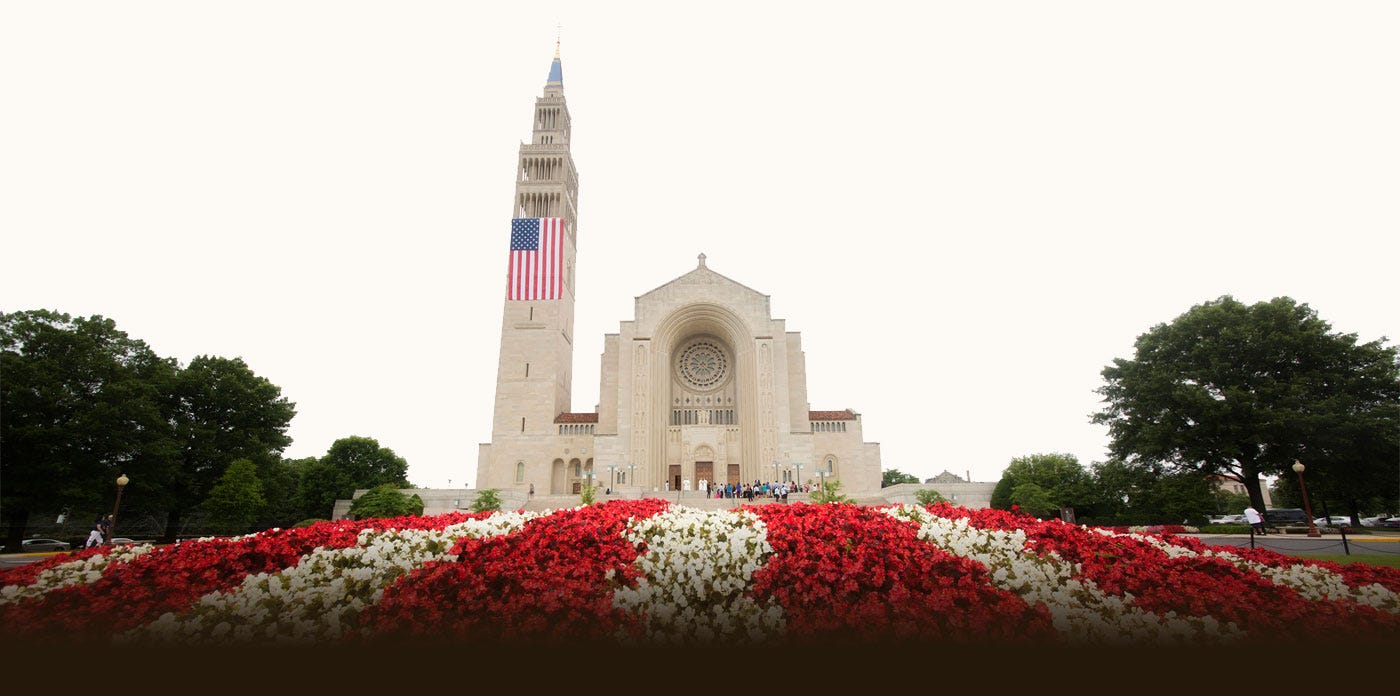
Construction on what is now the Crypt Church began in 1920; Bishop Thomas Joseph Shahan, the fourth rector of the Catholic University of America had launched the fundraising campaign back in 1913 and had received Papal approbation. In 1792, newly appointed Baltimore Bishop John Carroll had consecrated the nascent United States of America to the Immaculate Conception. In 1846, the 6th Provincial Council of Baltimore named “The Virgin Mary, conceived without sin” as patroness of the country; Pope Pius IX had the title proclaimed on July 2, 1847. There was and could be no question as to the dedication of what was intended to be the central Catholic Church of the nation. In four years’ time after construction, the Crypt Church was ready for use. On November 20, 1959, thousands of Catholics joined bishops for the dedication of the Great Upper Church. Various side chapels – usually to different titles of the Blessed Virgin - have been added at the instance of different ethnic groups, religious orders, and Catholic associations over the years.
The result is an amazing hodgepodge of styles; it reminds me of the much smaller Ordinariate church of St. Agatha’s in Portsmouth, England, which nevertheless has also served as a receiving point of innumerable types of ecclesiastical furniture, and yet somehow also works as place of prayer and holiness. In the Upper Church, over the Baldacchino, is an amazing mosaic of Christ in Majesty, by the Polish artist, Jan Henryk de Rosen. This striking piece has always struck me as appropriate for two reasons. The first is the face of Christ has seemed a bit angry, which is probably appropriate, given where the country is at the moment. The second is that the artist, a noted Polish muralist caught in the United States by the outbreak of World War II and unable to return to his Communist occupied homeland, spent the rest of his life creating artwork for a great many American churches, all across the country. All of his depictions of Christ are rather different from each other and this one; but they all attempt to give Christ a masculinity and strength that was often missing in His pictures in those days.

