

Does President Trump’s massive military operation in Iran constitute a just war? My view is that it woefully fails to satisfy the moral criteria for a casus belli, even allowing for the great latitude afforded the prudential judgment of political authority in the matter. This two-part article argues that Trump has manifestly failed to justify the Israeli-American war on Iran and, moreover, that his expressed intentions respecting the war would vitiate his claim of a casus belli even if one existed. I write, it must be noted, as a Trump supporter who views his election overall as nothing less than an almost miraculous providential mitigation of what could have been incalculable and irreparable harm to the common good of this country and indeed the world had that cackling buffoon the Democrats nominated been elected to the Presidency.
The Just War Criteria
First of all, Catholic doctrine has never excluded the waging of war for a just and proportionate reason, especially when it comes to defense against an aggressor. In the Summa Theologiae, II-II, q. 40, the Angelic Doctor sets forth the traditional moral criteria for a casus belli. He begins by answering a series of objections which amount to the proposition that waging war is always sinful, to which St. Thomas replies:
“On the contrary, Augustine says in a sermon on the son of the centurion [Ep. ad Marcel. cxxxviii]: ‘If the Christian Religion forbade war altogether, those who sought salutary advice in the Gospel would rather have been counselled to cast aside their arms, and to give up soldiering altogether. On the contrary, they were told: ‘Do violence to no man . . . and be content with your pay’ [Luke 3:14]. If he commanded them to be content with their pay, he did not forbid soldiering.’’”
That is, the sources of Revelation presume the legitimacy of armies, and thus the legitimacy of warfare in the appropriate case. As to what constitutes a morally legitimate casus belli, St. Thomas identifies three criteria:
• “First, the authority of the sovereign by whose command the war is to be waged.”
That is, the waging of war is not the prerogative of private parties but of duly constituted political authority. Application of that principle is surely complicated by the advent of the military-industrial complex of the post-Christian state.
• “Secondly, a just cause is required, namely that those who are attacked, should be attacked because they deserve it on account of some fault. Wherefore Augustine says (QQ. in Hept., qu. x, super Jos.): ‘A just war is wont to be described as one that avenges wrongs, when a nation or state has to be punished, for refusing to make amends for the wrongs inflicted by its subjects, or to restore what it has seized unjustly.’”
Indeed, precisely on the grounds of the legitimacy of armies and thus of warfare, St. Augustine defended the Church against the accusation that adherence to the Gospel undermined fidelity to the Roman Empire. In a letter to his friend Marcellinus of Carthage, the saint and martyr who served as secretary of state of the Western Empire under Emperor Honorius, Augustine protested:
“Let those who say that the doctrine of Christ is incompatible with the State’s well-being, give us an army composed of soldiers such as the doctrine of Christ requires them to be; let them give us such subjects, such husbands and wives, such parents and children, such masters and servants, such kings, such judges—in fine, even such taxpayers and tax-gatherers, as the Christian religion has taught that men should be, and then let them dare to say that it is adverse to the State’s well-being...”1
In City of God Augustine developed the theme that the Christian is obliged by his very religion to obey civil authority, even in matters of just warfare, and to work for the well-being of the State in whatever form it exists: “When it is considered how short is the span of life, does it really matter to a man what government he must obey, so long as he is not compelled to act against God or his conscience?”2 Therefore, Augustine elsewhere observed, even during the reign of Julian the Apostate “Christian soldiers served this faithless emperor, but as soon as there was question of the cause of Jesus Christ they recognized only Him who was in heaven. Julian commanded them to honor idols and offer them incense, but they put God above the prince. However, when he made them form into ranks and march against a hostile nation, they obeyed instantly.”3
• “Thirdly, it is necessary that the belligerents should have a rightful intention, so that they intend the advancement of good, or the avoidance of evil. Hence Augustine says …. ‘True religion looks upon as peaceful those wars that are waged not for motives of aggrandizement, or cruelty, but with the object of securing peace, of punishing evil-doers, and of uplifting the good.’ For it may happen that the war is declared by the legitimate authority, and for a just cause, and yet be rendered unlawful through a wicked intention.’”
That is, even a just war can be rendered unjust by what St. Augustine, as cited by St. Thomas, described as “The passion for inflicting harm, the cruel thirst for vengeance, an unpacific and relentless spirit, the fever of revolt, the lust of power, and such like things…”4

Continue Reading at Pelican Plus.
The Catechism of the Catholic Church summarizes traditional assessment of the legitimate casus belli thus:
• the damage inflicted by the aggressor on the nation or community of nations must be lasting, grave, and certain;
• all other means of putting an end to it must have been shown to be impractical or ineffective;
• there must be serious prospects of success;
• the use of arms must not produce evils and disorders graver than the evil to be eliminated. The power of modern means of destruction weighs very heavily in evaluating this condition.5
Under these traditional criteria, particularly given “the power of modern means of destruction,” not only does the war on Iran lack sufficient moral justification but could well constitute a crime against the community of nations because of the loss of civilian life, the suffering of innocents, terrorist attacks that would not otherwise have happened, and the massive disruption of the global economy it has already caused and is likely to exacerbate vastly if, which God forbid, Trump engages in the sheer lunacy of launching a ground war on Iranian territory.6
This war has been launched on flimsy pretexts of no greater weight than the flimsy pretext of non-existent “weapons of mass destruction” cited to justify the total debacle of the Iraq War and its consequent destabilization of the entire the Middle East and the persecution of Christians that always seems to result from United States interventions in places having no nexus to national security.
The Background of this Folly
By way of background to this latest military misadventure—by the only nation that has actually employed nuclear weapons in war, unleashing them on civilian populations—consider that it was the United States that created the conditions that led to the emergence of a radical Islamic dictatorship in Iran in the first place. It was the 1953 coup d’état, orchestrated by the CIA with the help of MI-6, that overthrew Iranian Prime Minister Mosaddegh and made the Shah a pawn of American power who feared his own deposition if he did not cooperate in the coup. And it was the entrenchment of the Shah with US assistance that led to the Iranian Revolution of 1979, the abolition of the Iranian monarchy, the creation of the radical Islamic Republic, and what David Stockman rightly describes as “the benighted rule of the mullahs that the geniuses on the Potomac helped bring to power” after the Shah’s overthrow.
The Iranian debacle was repeated by our geopolitical wizards in Iraq, which is now ruled by fanatical Shiites who have driven almost all the Christians out of the country.7 Indeed, the replacement of one dictator with a worse dictator, followed by the persecution of Christians, has been the outcome in every single instance of the United States’ blundering foreign policy over the past 75 years. We have seen this most recently in Syria, which, as the Open Doors organization notes, has since the fall of Assad become “the sixth most dangerous place in the world for Christians in 2026.”8 The same is true in Afghanistan, which is now “a place of extreme persecution for anyone who dares to follow Jesus under the brutally oppressive rule of the Taliban.” Christians “have either fled the country or gone deeper underground. As far as the Taliban is concerned, it is not possible that any Afghan could be a Christian.”9 So too in Libya, where the U.S.-orchestrated overthrow and execution of Muammar Gaddafi produced a failed state ruled by warlords, many of whom are jihadists. As Open Doors observes: “The absence of a single central government to impose law and order has made the situation for Christians precarious. The level of violence against Christians in Libya is categorised as ‘very high’” and “Christians are in danger everywhere in Libya, but particularly where violent Islamic extremists are active. The few converts from Islam are also extremely vulnerable and are forced into the shadows.”10 But, as the National Catholic Register recalls, under Gadaffi—is anyone surprised?—“the Catholic Church functioned more or less freely without much government interference. During that time, there had been relatively good relations between Christians and Muslims.”11
With this background of disastrous failure and the just war criteria in view, let us now consider the sham pretexts for Trump’s war on Iran—launched by Israel’s first strike in keeping with its 30-year-long push for what is happening now.
The “Forty-Seven Years of War” Canard
Recall that Trump insisted that the pinpoint of bombardment of three uranium enrichment facilities in Iran had “totally and completely obliterated” its alleged (but never proven to exist) nuclear weapons development program. Mission accomplished, we were assured. Iran had been prevented from developing the A-bomb we had been warned incessantly over the past 25 years was only years, or months—no, wait, days!—from completion. But, his necktie having been caught in the ceaselessly grinding gears of the American War Machine, Trump allowed himself to be pulled all the way into a mechanism that is now focused on Iran as the latest target for a mighty show of irresistible force directed against a puny, non-nuclear, fourth-rate military power that poses no threat whatever to the American homeland.
No sooner had Iran’s nuclear development capacity been declared “obliterated” and the latest phantom Great Crisis averted than we were informed that Iran has “been at war with the United States for the past 47 years”—didn’t you know? I quite agree with David Stockman that this is “a mindless and fraudulent concoction from the White House coms department that has apparently been focus group-tested exclusively on elementary school children or MAGA Kool-aid drinkers, as the case may be.” As a Trump supporter I am constrained to admit that there are indeed MAGA Kool-aid drinkers whose lockstep endorsement of this war will only undermine the perfectly legitimate elements of the MAGA movement with potentially apocalyptic results for the American body politic.12
Stockman is quite right to observe what should be obvious to anyone who subscribes to the America First political program:
In fact, from the CIA engineered coup d etat against Iran’s democratically elected Prime Minister in 1953, to Washington’s aid to Saddam Hussein during Iraq’s 1980s invasion of Iran, to the crushing economic sanctions which have been battering Iran’s economy for years since the 1990s, to the Donald’s bombing raid on Iran’s nonexistent nuclear weapons program last June, there’s been a war alright. But it is one that has originated far more in Washington than in Tehran—a truth that becomes starkly evident when you grasp just one cardinal fact: Namely, that Iran has never, ever mattered to America’s “Homeland Security”.
Iran has never committed an act of war against the Homeland; it is simply incapable of doing so. On the other hand, 15 of the 19 hijackers on 9/11 were from Saudi Araba, 2 from the United Arab Emirates and one from Egypt—all our supposed allies in the Middle East. All of the terrorists who acted on American soil were members of Al-Qaeda, as were those who bombed the of U.S. embassies in Kenya and Tanzania in 1998 and conducted the 2000 attack on the USS Cole in Yemen. It was not Iran, but Afghanistan and the Sudan against which the U.S. launched airstrikes in retaliation for those embassy bombings. Iran was out of the picture.
As for Iran’s alleged present-day support for Hamas and Hezbollah, what does this have to do with our homeland as opposed to the endless conflict between Israel and, more or less, every one of its neighbors in the Levant? U.S. casualties in the region have directly resulted from our insertion into that conflict on Israel’s behalf; and it is only U.S. involvement in terms of military bases, weapons, treasure and blood that has allowed Israel to sustain its perpetual warfare in the Middle East. Consider this graphic depiction of the preposterous profusion of U.S. military bases in the region (full withdrawal from Iraq having finally been scheduled for this year):
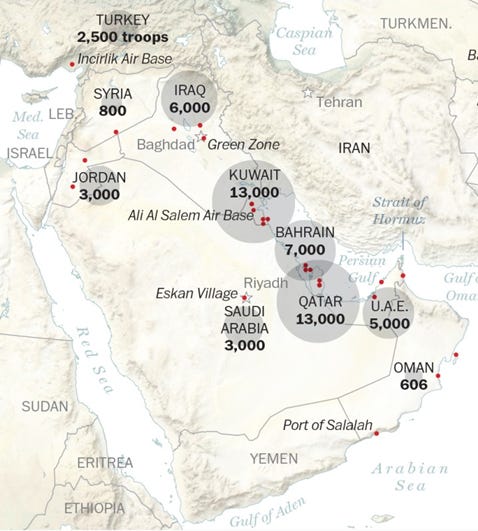
What are all those bases doing there? Benefitting Israel throughout the Arab-Israeli conflict provoked by Israel’s creation in 1948. One source notes that U.S. bases have been used at least 25 times to launch wars of choice in the greater Middle East.13 Wars for what? Wars of no benefit to the United States but of ultimate benefit to Israel. What is the greatest single inducement to Al- Queda recruitment in the Middle East? Answer: the U.S. military presence—established and maintained for the benefit of Israel and thus always under threat from terrorist attacks in the asymmetric war between elements of the Arab world and the Israeli nation-state inserted into its midst nearly eighty years ago pursuant to UN Resolution 181—backed by the United States.
But what about all those “proxies” by which Iran is alleged to have been engaging in war against the United States for 47 years? A brief explanation by a professor of international affairs at American University presents the case only to demonstrate its utter flimsiness as a pretext for the war on Iran: “Iran supports Hamas, Hezbollah, and the Houthis in Yemen, among other terrorist organizations. Iran has also backed groups that bombed the US Embassy in Lebanon, attacked US soldiers in Iraq, and fought against US allies in Syria.”14
The bombing of the embassy in Lebanon was forty-three years ago during the Regan administration, the Islamic Jihad Organization claimed responsibility for the act, and Iran denied any involvement, which has never been proven. The conflict in Yemen is none of the United States’ business; the Iraq War was a US war of aggression denounced by Trump himself as an epochal folly he would never repeat; and fighting against “US allies in Syria”—that is, the radical Islamic factions of choice by US foreign policy bunglers—is hardly an act of war against the United States.
The professor’s further explanation completely undermines the “Iranian proxies” argument: “Iran is in a long-term conflict with the US. Similar to the conflict with Saudi Arabia, it is mostly a cold conflict fought through proxy competition. Iran tends to back groups that run counter to US interests in other conflicts. Iran inserted itself into the Syrian civil war to counter US interests, as well as doing the same in Iraq.” In other words, Iran’s “war on the United States for 47 years” amounts to Iran allegedly backing groups whose aims are counter to the groups backed by the US in conflicts that are none of our business as Trump himself insisted during the run-up to his reelection.
Applying just war criteria to this pretext for war, we find no justification at all.
First, there is no just cause as there has been no act of war against the United States, as opposed to Iran’s alleged connection to groups opposing US interests in Middle East conflicts of no relevance to our domestic security as opposed —yet again—to Israel’s objectives in the Levant.
Second, whatever damage Iran is alleged to have inflicted on the community of nations via proxies has occurred in the context of conflicts the US itself initiated or into which it has inserted itself without any justification of defense of the American homeland as opposed to the Israeli homeland.
Third, there are no serious prospects of success in this war of choice. The already morally impermissible “decapitation” of Iran’s leadership—that is, their state-sponsored summary executions—has not led to regime change. Rather, as John Mearsheimer observes, the Iranian people have rallied around the Iranian flag in the midst of Trump’s chest-thumping destruction of Iran’s puny military capacity—alongside and for the benefit of Israel, of course—as civilian deaths mount with no end in sight.15
Fourth, when Trump declared that the US is “bombing our little hearts out”16 in Iran he practically stipulated to a motive that vitiated any argument for a just war, even if he had one. To recall St. Augustine’s teaching, war loses its justification when motivated by “the passion for inflicting harm, the cruel thirst for vengeance, an unpacific and relentless spirit… the lust of power, and such like things.” In that case, says St. Thomas, a war can be “declared by the legitimate authority, and for a just cause, and yet be rendered unlawful through a wicked intention.” A wicked intention is exposed by Trump’s own words.
Finally, annihilation of Iran’s insignificant navy and air force, which posed no threat whatsoever to the United States, was a senseless act of wanton destruction that inevitably resulted in civilian casualties, including children, attacks on US bases throughout the Middle East, which are now uninhabitable,17 and the closure of the Strait of Hormuz with grave economic consequences for the global economy, particularly in the United States. Moreover, Iran’s forces will only be rebuilt with the help of the oil revenue now flowing from Trump’s lifting of the oil sanctions on Iran as well as Russia in order to remedy the oil shortage in the international market his own war has caused by provoking the Iran’s closure of the Strait.18 Thus, it is obvious that Trump’s use of arms has produced and will continue to produce “evils and disorders graver than the evil to be eliminated.”
In the concluding part of this article, I will examine the remaining—even flimsier—pretexts for this latest US war of choice. I will also argue that it will be Trump’s, and ultimately our, undoing if he escalates this insanity into any form of ground invasion rather than doing what he must by ending this war immediately—thus accepting what is already an enormously counterproductive failure, just as the US was forced to do in Iraq. Will Trump accept that humiliating failure or will he, out of desperation, climb up “the ladder of escalation,” as Mearsheimer puts it, turning this debacle into a potentially global catastrophe in pursuit of what Mearsheimer rightly calls Trump’s “ridiculous” 15-point “peace plan”? That is the terrifying question now confronting us as Trump, obediently following Israel’s lead, irrationally abandons the non-interventionist foreign policy that helped propel the greatest political comeback in Western history.
1. Letter 138, 2.15.
2. City of God, V.17.
3. Enarrat, in Psalm. CXXIV, n. 7, fin. In Leo XIII, Au Milieu Des Sollicitudes (On the Church and State in France).
4. Contra Faust. xxii, 74.
5. Catechism of the Catholic Church, § 2309.
6. Report: Pentagon Preps Massive ‘Final Blow’ vs Iran — Seizing Strategic Islands as U.S. Weighs Sending 10K Combat Troops.
7. “Iraq’s Christians are Vanishing, March 27, 2026,”
8. “Drastic rise in Syrian persecution of Christians”, The Catholic Register, January 14, 2026.
9. Open Doors, Afghanistan, World Watch Ranking, “What does persecution look like in Afghanistan”?
10. Open Doors, Libya, World Watch Ranking, “What does persecution look like in Libya?”.
11. “Uncertain Future for Christians in Libya,” National Catholic Register, September 11, 2011.
12. David Stockmanm, Washington’s Latest Big Lie: Iran’s 47-Years War on America, March 11, 2026.
13. Cf. overseasbases.net
14. Nicole Hassenstab, “Understanding Iran’s use of terrorist groups as proxies,” February 5, 2024, American University.
15. John Mearsheimer: “Iran Holds All the Cards” - The Strategic Defeat of the U.S.
16. Trump says US will ‘keep bombing our little hearts out’ if they can’t make a deal with Iran
17. Report: Many Middle East US Bases “All But Uninhabitable” Due to Iran Strikes
18. Trump Lifts Sanctions on Iranian Oil in WILD Turn of Events.