

Bishop Marian Eleganti has issued a fresh critique of the Synod on Synodality promoted by the Synod Secretariat, accusing it as being aimed at changing Catholic teaching on marriage, homosexuality, ecclesial leadership, and ecumenism.
Penning a commentary about the latest release from the General Secretariat of the Synod of Bishop, Bp. Eleganti delivered an excoriating critique of the synodal process, which is now due to being a two year implementation phase of the 3-year synod.
“The Church in our region is sick: the synodal ‘occupational therapy’ ordered by the Vatican offers no cure,” he argued.
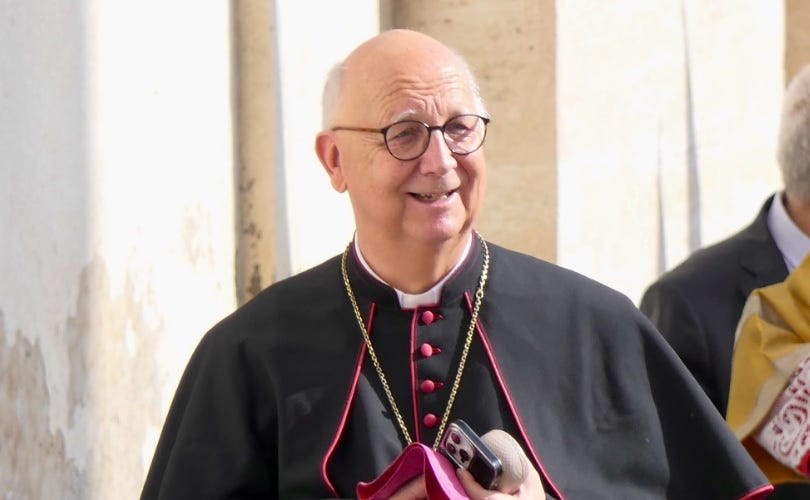
Eleganti, the emeritus auxiliary bishop of Chur, has been a consistent and vocal critic of the Synod on Synodality, warning that the event risks undermining the integrity of the Catholic faith in doctrine, morals and law.
Concerns about the Synod have been renewed in recent weeks following the highly controversial Study Group 9 report promoting homosexuality, and the announcement this week of a two-year implementation phase essentially redoing the entire Synod.

In Eleganti’s assessment there remains little doubt about the true intentions of the Synod:
“It has become clear by now what the process aims for: a restructuring of the Church’s long-standing and unshakable doctrinal positions regarding divorce and remarriage, homosexuality (the entire queer agenda), the synodal democratization of Church leadership, new roles for women, and ecumenical and interreligious progress at the expense of its own Catholic identity.”
Throughout its three-year process, the Synod came under criticism for its apparent promotion of controversial and ideological talking points, at the cost of safeguarding Catholic doctrine. The questioning of unchanging teaching regarding Holy Orders, sexuality was very notable, as were attempts to restructure the Church’s ordained hierarchy.
“The broad and simple people of God stand on the sidelines” of the Synod, noted Eleganti, while instead “it is the full-time actors of this dysfunctional committee-driven church who are occupied, at great expense, with the commissioned steering mechanisms and synodal documents.” The result – endless documents, “heterodox study results, and newly devised committees (to add to the many that already exist).”
Synod organizers prioritized the listening to and “inclusion” of those identified as being on the “margins,” such as non-Catholics and Catholics who actively reject Church teaching. According to Eleganti, this inclusion “mainly concerns the normalization of homosexuality within the Church and is nothing more than a revision of its doctrine on issues that have remained unchanged for 60 years.”
Opining as to how such talking points became so widely accepted, he wrote: “Apparently, we have enough homosexuals in the clergy and the church hierarchy who, just as insistently and tirelessly as in the rest of society, shove the rainbow colors in our faces at every opportunity and believe they are closer than ever to their goal.”
Instead, the bishop urged the Vatican to turn its gaze towards the liturgy, since the Synod “has indeed yielded nothing but full-time busyness, an overkill of words and directives, but no supernatural life in the hearts of the faithful.”
“We should once again make the altar the center of the Church,” he recommended.
Eleganti previously spoke to this correspondent in a wide-ranging December interview, in which he emphasized the attraction of young people to the more reverent and ancient forms of the Church’s liturgy.
Re-iterating this aspect, Eleganti pointed to the silence of the traditional liturgy and how such liturgical silence fosters spiritual growth. In contrast, he attested that “in the post-conciliar church, there is constant talking, both liturgical and synodal. There is practically a compulsion to do so, because the mystery before which one kneels to receive from CHRIST all that brings true life has been lost.”
Ad orientem worship must return, he insisted, in order to refocus the Mass on Christ. “We must turn back, turn toward Him, and look up to Him… We should reflect on all this—not necessarily talk about it, but change it, each of us for ourselves!”
Bishop Eleganti’s full commentary is found below ---
The Church in our region is sick: the synodal “occupational therapy” ordered by the Vatican offers no cure!
What comes from Rome—I mean the workshop of the so-called “synodal process” proclaimed by the universal Church—is mere human wisdom. Evidently, the protagonists have nothing better to do than to repeatedly issue directives to the local churches on how the synodal process—a stillborn endeavor from the start—should be managed and kept running. They believe they can channel the Holy Spirit, and that He will find His way to the faithful through the pipelines they have laid. The result is the bureaucratization of a desired renewal and mission.
The broad and simple people of God stand on the sidelines. It is the full-time actors of this dysfunctional committee-driven church who are occupied, at great expense, with the commissioned steering mechanisms and synodal documents. All that comes out of this are documents to be read over and over again, heterodox study results, and newly devised committees (to add to the many that already exist).
Yet it would be enough if every Catholic were truly one: the salt of the earth. The Holy Spirit would work through them. But at work are professional Catholics who take a break again in their free time. Many of them do not even attend Sunday Mass regularly. But of course they know how the Church must be renewed; one can then read about it—cleverly conceived ideas.
This also applies to the architects of this synodal process in Rome. It has become clear by now what the process aims for: a restructuring of the Church’s long-standing and unshakable doctrinal positions regarding divorce and remarriage, homosexuality (the entire queer agenda), the synodal democratization of Church leadership, new roles for women, and ecumenical and interreligious progress at the expense of its own Catholic identity. One must indeed search for this identity. The touted inclusion mainly concerns the normalization of homosexuality within the Church and is nothing more than a revision of its doctrine on issues that have remained unchanged for 60 years. A lot of fuss over an agenda that’s easy to see through. Apparently, we have enough homosexuals in the clergy and the church hierarchy who, just as insistently and tirelessly as in the rest of society, shove the rainbow colors in our faces at every opportunity and believe they are closer than ever to their goal.
But the fact that the Council documents no longer apply is indeed surprising. The Council still spoke of a fundamental difference between the ordained priesthood and the non-ordained laity; it spoke of the unity of ordination and jurisdiction/leadership, of a hierarchically ordered People of God. All water under the bridge! Today, this unity of ordination and leadership (jurisdiction) desired by the Council is being destroyed not only by the Society of St. Pius X (with their auxiliary bishops lacking jurisdiction), but also by those in Rome and among us who make laypeople heads or prefects of dicasteries, with bishops as their subordinate assistants or co-leaders, here, into parish leaders and heads of pastoral units and parishes with so-called “collaborating” priests as their subordinates.
But they’re counting their chickens before they hatch—without accounting for the much-cited Holy Spirit. He takes entirely different paths. Look at the many young baptismal candidates—a growing phenomenon, but not a fruit of the synodal process.
The Church would do better to turn its attention to the liturgical question if it does not want to watch as its ship continues to drift away, down the river. That is exactly what I wish for this synodal process, from which I expect nothing. So far, it has indeed yielded nothing but full-time busyness, an overkill of words and directives, but no supernatural life in the hearts of the faithful. This would come from a true conversion, from the shedding of one’s own blood. The processes, by contrast, are figments of the imagination; they do not get into the blood, at least not into mine. I am probably not the only one.
It will become clear that this attempt to renew the Church and reformat it in the interests of its own agenda—think of the touted paradigm shift from the apostolic to the synodal Church—will fail. Worse still, it is already today an accelerator of centrifugal forces and new threats of schism, both internal and external!
Perhaps we should once again make the altar the center of the Church. Perhaps everyone in the Church should consider that without the priest there is no Holy Mass, and without Holy Mass there is no Church. A priestless Church—which some among us dream of, those who marginalize or supplant the priest and believe the hour of the laity has come—will disappear.
Many young people are therefore so drawn to the old liturgy. But it is silent (especially at the climax). In the post-conciliar church, there is constant talking, both liturgical and synodal. There is practically a compulsion to do so, because the mystery before which one kneels to receive from CHRIST all that brings true life has been lost. We must turn back, turn toward Him, and look up to Him. The priests, however, look toward the congregation, which defines itself according to secondary categories and then celebrates the liturgy as the subject of those categorical liturgies. The priest is merely the presider of the assembly. CHRIST, the main attraction (literally and figuratively!) of every service, slips from their view. Even the Pope pushes Him aside in the papal Masses, which become above all an encounter with him, the Pope (a “superstar”?), not with CHRIST. We should reflect on all this—not necessarily talk about it, but change it, each of us for ourselves!
The Faithful have been betrayed by this sodomite Vatican. Just ignore everything they say.
the truth