

Cardinal Robert Sarah has called for “clarifications” on the Second Vatican Council, saying that the Council must be read in “continuity” with the unchanging Catholic faith.
In a recent interview, Cdl. Sarah – the 80-year-old former prefect of the Congregation for Divine Worship – has once again waded into the question of the Second Vatican Council and its impact on the Church of today. Speaking to French outlet La Nef, Sarah downplayed concerns about the Council needing “corrections,” and instead called simply for “clarifications.”
“I would first talk about clarifications rather than corrections,” he said. “A council must be read in continuity with the faith of all time. Where certain texts have given rise to divergent, even opposing, interpretations, it is legitimate to ask for further investigation, in order to rule out disruptive readings.”
The cardinal urged that attempts to work on such “clarifications” would be a benefit to the Church, since She has “nothing to fear from clarity.” Interpretation of the Council, he added, “falls to the Magisterium. It was largely initiated by John Paul II and Benedict XVI.”
Though known as one of the more liturgically conservative members of the College of Cardinals, Sarah has shied away from the firmer criticism of Vatican II which other prelates have made. Instead he has urged efforts to seek continuity in the teaching before and after the Council.
But interviewed by La Nef, the Guinean cardinal identified areas of the Council in which he deemed the Church needed to have “more precise work,” saying also that it is no secret about the necessity for such work.
“Religious freedom, ecumenism, the relationship between the Church and the modern world, collegiality, certain pastoral formulations whose use has sometimes encouraged a hermeneutics of discontinuity,” he listed.
“But great inner peace is needed here,” added Sarah, “it is not a question of judging the council as one judges a political program. It is about serving the more unified intelligence of faith.”
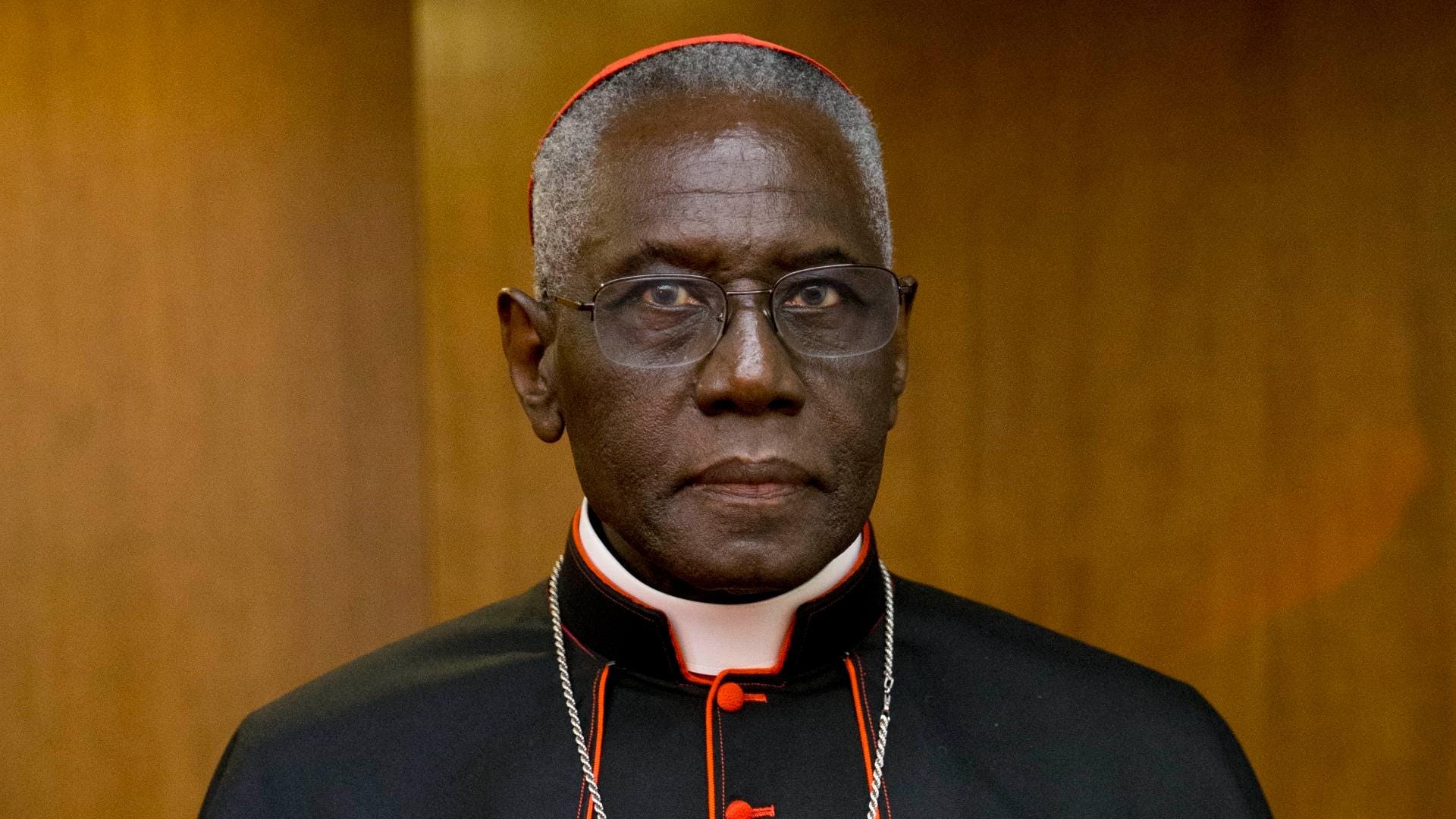
As on previous occasions he rejected the idea of a rupture in doctrine, saying that “the teaching of the Church does not contradict itself. It is always the same since it is nothing other than the revelation transmitted by Christ, constantly deepened and always better understood.”
The subject of Vatican II is one which is rarely out of ecclesial news, but it is especially at the moment that renewed attention is afforded to it. Much of the more controversial and heterodox elements of Pope Francis’ reign were described as the continuation and realization of Vatican II, in turn serving as a catalyst for the Society of Saint Pius X’s decision to consecrate new bishops.
SSPX Superior General Don Davide Pagliarani mentioned this aspect explicitly, stating recently that:
“With the legacy left to us by Pope Francis, the fundamental reasons that justified the consecrations of 1988 still exist and, in many respects, impel us with renewed urgency. The Second Vatican Council remains more than ever the compass guiding today’s churchmen, and they are unlikely to change course in the near future. Furthermore, the major orientations already taking shape in this new pontificate—particularly through the most recent consistory—only confirm this. An explicit determination to preserve the line of Pope Francis as an irreversible trajectory for the entire Church is discernible.”
Pagliarani added that the Society’s discernment of a “state of emergency” in the Church was linked to the continuation of the Council: “I admit to having been struck in recent years by the bitter and systematic reaction of a certain rather short-sighted conservative milieu, which has attacked in a very personal way the figure of Pope Francis, rather than the Council and the continuity of its doctrinal application to the present day.”
Sarah has also pointed to the doctrinal and liturgical crisis which has emerged since the Council, but always separated it from the Council itself. Delivering a conference in 2017, Sarah highlighted the “serious, profound crisis that has affected the liturgy and the Church itself since the Council is due to the fact that its center is no longer God and the adoration of Him, but rather men and their alleged ability to ‘do’ something to keep themselves busy during the Eucharistic celebrations.”
He has also commented how while “many believe and declare loud and long that Vatican Council II brought about a true springtime in the Church,” a “growing number of Church leaders see this ‘springtime’ as a rejection, a renunciation of her centuries-old heritage, or even as a radical questioning of her past and Tradition.”
But this is not the fault or intention of the Council itself, he opined, saying: “the true purpose of the Second Vatican Council was not to start a reform that could become the occasion for a break with Tradition, but quite the contrary, to rediscover and to confirm Tradition in its deepest meaning.”
For Sarah, it is “ideologues” who “want to set the pre-Council Church against the post-Council Church. They are dividers; they are doing the work of the devil.”
However the cardinal’s view is not shared by all among the traditional sphere. Bishop Athanasius Schneider has echoed Sarah in urging “a respectful attitude” towards the Council, warning against “throwing the baby out with the bath water,” but also noting how “several expressions in the texts of the Second Vatican Council cannot be so easily reconciled with the Church’s constant doctrinal tradition.”
“Through the Second Vatican Council, and already with Pope John XXIII, the Church began to present herself to the world, to flirt with the world, and to manifest an inferiority complex towards the world,” he lamented.
Such interventions are of course but a taste of the lively debate surrounding the Council, its aims, texts and interpretations – a debate which has increasingly and necessarily come to the fore in the Church’s life in recent years.
With the SSPX’s planned episcopal consecrations in July, it is the considered opinion of many analysts and clerics that the Holy See should take the opportunity to thoroughly and honestly examine the “fruits” of the Council and the spiritual health of the Church.
Connect with the author on Pelican+ Social


61 years after the conclusion of the second robber council, we are still looking for “explanations” and “interpretations”.
Cardinal Sarah mostly represents the position of SSPX: “Religious freedom, ecumenism, the relationship between the Church and the modern world, collegiality, certain pastoral formulations whose use has sometimes encouraged a hermeneutics of discontinuity,” he listed." Attend the Latin Mass.