

The first day of the June consistory saw a papal call for unity and obedience, before cardinals discussed emerging themes facing the Church, along with the Pope’s recent encyclical. What was absent however was any mention of the more polemical and high profile issues in the Church today, such as the liturgical question or the Society of St. Pius X.
Friday morning marked the opening of the second consistory of the year, which has brought around 180 cardinals to Rome for the few days of meetings. Four sessions will be held in total, with two now completed and the final two taking place on Saturday.
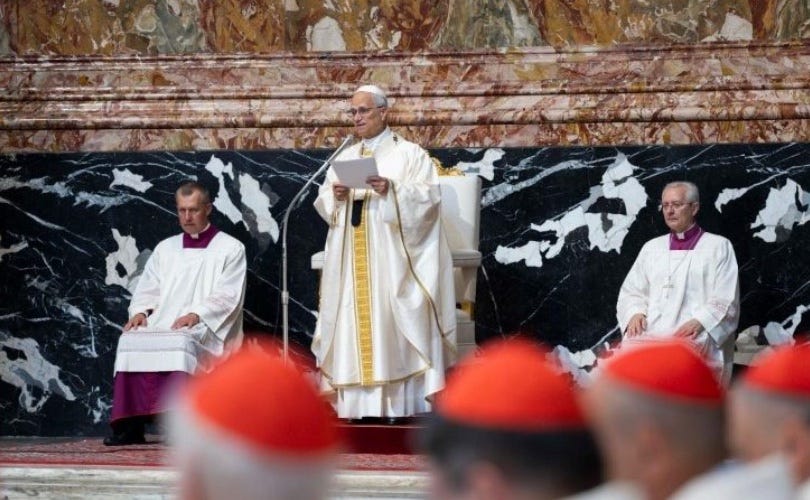
Of these, the beginning session was arguably the most open in terms of what might emerge, given that it was on the theme of the Church proclaiming the Gospel in the current world and the challenges inherent to this. Yet no particular notable concerns appear to have been raised by the cardinals, according to the information provided by the Holy See. {Strict secrecy is being enforced on the cardinals during the consistory}
Both in the morning and afternoon the various table groups highlighted a need for the Church to respond to:
Growing polarization in society and the myriad effects.
Lack of respect for religion in many countries and the violence against the Church.
“The rise of antisemitism.”
Family break ups leading to drug and alcohol abuse, suicide and worsening conditions for children.
Secularism robbing people of a sense of purpose and meaning in life.
The question of migration and responding in “a humane and Christian manner.”
Ecological issues and concerns.
For the Church to be a “credible witness” in the quest for peace. In this capacity they spoke about “a language that facilitates the search for unity within the Church.”
Based on the peace-quest they called for a united front from Christians and other creeds. More dialogue with Islam was also highlighted on this aspect.
They discussed political power, the need to move to longer term sustainable projects rather than immediate responses, and “a bold work of evangelization, since determination stems from the Gospel, from life, and from faith.”
“The need to work together with leaders of other religions to affirm the civilization of love.”
Many of the table groups pointed to a wide sense in the global population of “distrust, fatalism, and powerlessness toward institutions, democracy, and the future,” all factors cited in the increase in substance abuse and the decline in births.

https://app.pelicanplus.com
“All the groups,” stated the Vatican, “emphasized the need for the Church to present itself as a mother, a welcoming place—including through the restructuring of parishes—capable of acknowledging its own mistakes and transforming suffering into an opportunity for growth, reminding the world that we are one human family.”
In light of these numerous crises in society, many of the table groups attested that the Church must “speak with authority in favor of human dignity, peace, reconciliation, and the common good.” They added that, in so doing, the Church can “find the credibility that is lacking in other institutions.”
Pope Leo was in attendance at the opening and closure of each of Friday’s two sessions, and is anticipated to be present on Saturday afternoon for the sole time-slot set aside for free interventions.
As already reported, the cardinals are divided into two halves: nine groups will be made up of cardinal-electors, while eleven groups will be made up of cardinal-electors serving in the Roman Curia and all those cardinals too old to vote. There are 8 of cardinal-electors and 10 of the mixed second group.
Only groups of cardinal-electors were due to deliver the results of their table discussions before the entire room, but in the end all 8 cardinal-elector groups gave reports as did 4 also from the second mixed groups.
The Just War Doctrine had officially been removed from the schedule, after being newly inserted in May. Nevertheless, according to the Vatican, “numerous groups agreed on the need to move beyond the logic of a ‘just war,’ since the Gospel is not imposed by force, and to speak instead of the right to proportionate self-defense.”
Great appreciation was expressed to Leo for writing his encyclical Magnifica humanitas, particularly regarding the work’s call for peace. In that vein, cardinals reportedly urged more demonstrations of the Church’s role in leading the quest for peace, such as events born out of the 1986 Assisi meeting.
Thanks to the format of the consistory laid out by the organizers, the cardinals’ discussion appears to have remained very much on sociological questions, more than internal ecclesial ones. Issues such as moral crises, lack of practice of the faith and confusion about Church teaching was not apparent in the table group reports – in large part because this was not anticipated by the schedule.
Saturday’s sessions will likely be more revelatory given that there is at least an opportunity for free interventions.
But it seems that the small table format is very much ensuring that discussion stay largely uniform by the time reports are read out in front of the assembly. This methodology was criticized by many after January’s, yet Leo has notably ignored such concerns and even informed cardinals today that they must commit to the new style of consistories.

A conversation with random person at Bar, after second glas of wine, has more depth than Vatican II Organisation and its documents… besides, demanding obedience has its area of focus, like Truth. The bishops are tasked with transmitting and safeguarding the one Catholic truth.Truth with its contents stands at the beginning. Unity and obedience are permitted by God only under the condition and within the framework of eternal truths.