

Did Leo XIV just rewrite history on Fiducia Supplicans? That was the impression which the American Pope gave at the close of his in-flight press conference on April 23, returning from Equatorial Guinea and his four-nation Africa tour.
The penultimate question during the now customary encounter with the journalists was about same-sex blessings, in light of news about Cardinal Reinhard Marx urging his priests to offer such blessings.
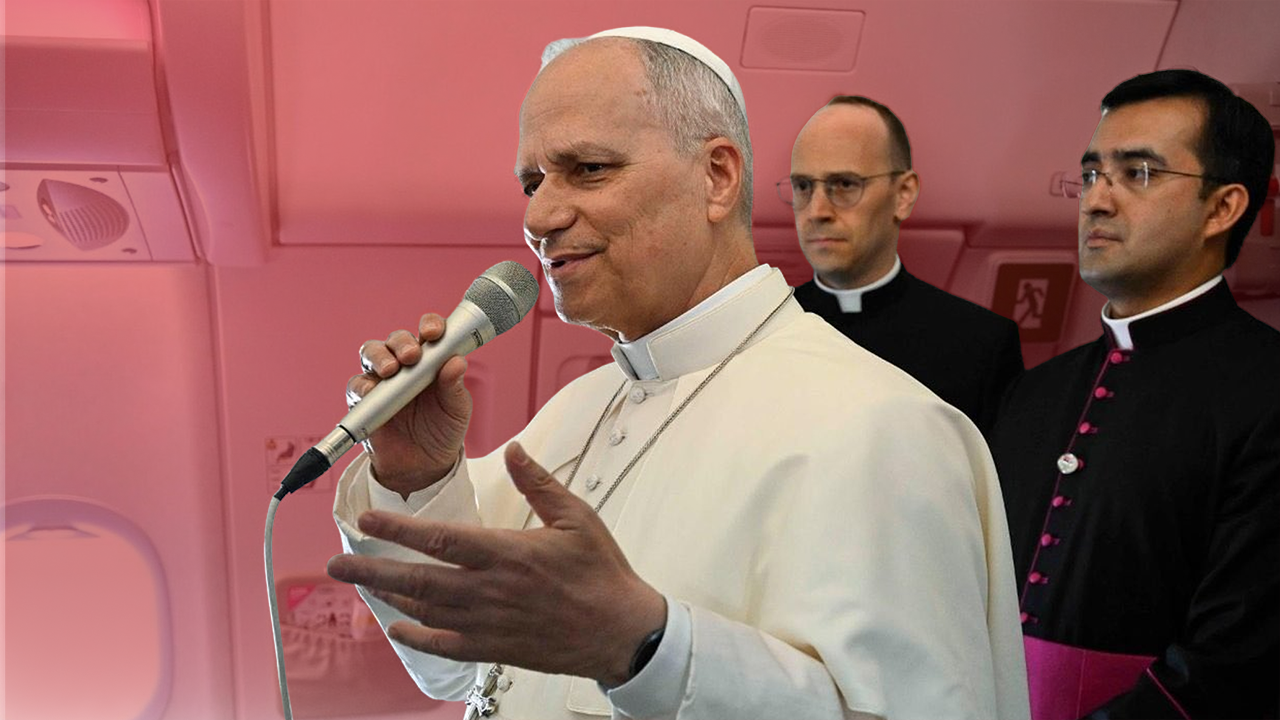
Leo first somewhat downplayed the topic of sexual morality by saying that “the unity or division of the Church should not revolve around sexual matters.”
Other “more important issues” should take priority, he said, listing “justice, equality, freedom of men and women, freedom of religion” as examples. While sins against the Church’s moral teaching are greatly prevalent throughout society, it is true that such actions are not the most grievous in moral weight when contrasted with a rejection of God’s existence.

Continue Reading or Listening on Pelican Plus
But having made this preliminary note, as if by way of calming the waters, Leo then proceeded to wade in firmly against any moves to approve same-sex blessings.
“The Holy See has already spoken to the German bishops,” he said. “The Holy See has made it clear that we do not agree with the formalized blessing of couples, in this case, homosexual couples, as you asked, or couples in irregular situations, beyond what was specifically, if you will, allowed for by Pope Francis in saying all people receive blessings.”
Describing what such a blessing might resemble, Leo added:
“When a priest gives a blessing at the end of Mass, when the Pope gives a blessing at the end of a large celebration like the one we had today, they are blessings for all people. Francis’ infamous, famous expression ‘Tutti, tutti, tutti’ is an expression of the Church’s belief that all are welcome; all are invited; all are invited to follow Jesus, and all are invited to look for conversion in their lives.”
Leo was reluctant to make any further comment on the topic, stating that “I think that the topic can cause more disunity than unity, and that we should look for ways to build our unity upon Jesus Christ and what Jesus Christ teaches.”
There are many aspects to the pope’s answer, including those which are somewhat contradictory at times.
Firstly his statement about the Vatican’s firm rejection of blessing same-sex couples is undeniable. For Leo, the Church clearly cannot bless couples of the same-sex.
In making such a pronouncement he thus echoes the February 2021 response to a dubium from the Congregation for the Doctrine of the Faith which forbade any blessing of same-sex couples in their capacity as couples. That note read: “As for unions of persons of the same sex, the response to the dubium ‘declares illicit any form of blessing that tends to acknowledge their unions as such.’”
But then Leo refers to Pope Francis, saying that the Church does not allow blessing of homosexual couples, “beyond what was allowed for by Pope Francis in saying all people receive blessings.”
This is true: Francis did say that all people can be blessed and this has been the case throughout the Church’s history. The late pope made these comments in light of the furor and controversy which erupted with the 2023 publication of Fiducia Supplicans.
However, Francis had previously gone further than that, by stating in that ill-fated document that there is “the possibility of blessings for couples in irregular situations and for couples of the same sex.”
Leo thus appears to have selectively chosen certain of Francis’ statements on the topic of same-sex blessings, and whitewashed others from history.
There are many voices currently arguing that by citing Francis, Leo thus gave his personal support to same-sex blessings. This is categorically false given that the Pope expressly denies the possibility of these.
But nor did Leo come out with a formal condemnation of Fiducia Supplicans – like many have wished for him to do.
Interviewed by this correspondent in October, Bishop Athanasius Schneider stated about Fiducia Supplicans that “this document must be abolished, because it is evident – as it is worded highly ambiguously in a matter which is important for the Church, for people even outside the church – that even Catholics read this as a text blessing same-sex couples.”
It seems almost implausible that Leo might now take such a formal step.
Instead, what he appears to be doing is trying to rectify the message and change the narrative. With his statement and the carefully selective citing of Pope Francis, Leo effectively removed Fiducia Supplicans from the record.
He re-iterated the unchanging teaching of the Church about the impossibility of blessing such unions, along with affirming the possibility of blessing individuals who ask for a blessing, or who receive one in a general manner as at the end of Mass.
The issue remains that Fiducia Supplicans has still been promulgated and is technically still in force. Commentator Matt Gaspers opined that Leo’s comments amounted to “a rather significant whitewashing of what Francis ‘allowed for’ in Fiducia Supplicans,” and this is certainly true.
Yet Leo’s style, as increasingly demonstrated in recent weeks, appears to be taking something of Francis’ – be it a word, phrase, document or theme – and twisting it somewhat into orthodoxy. The American Pope is desperate for peace and unity in the Church and this appears to be his mode in achieving it.
This leads us to the contradiction placed on display on Thursday.
Leo stated that the Church does not approve of blessing same-sex couples, yet Fiducia Supplicans states the Church does, whilst the CDF’s 2021 note states the Church does not and cannot.
Commentators on both sides of the aisle are attempting to twist Leo’s words to suit their own particular agendas, but one fact remains despite any such efforts – the Church’s timeless teaching prohibiting the blessing of sin remains the same as it always had.
Leo appears to be taking a very soft way of emerging from the gaping hole into which Fiducia Supplicans led the Church. The question is whether it will work?
Connect with the author on Pelican+ Social

Ambiguity all the way down. He repudiated nothing of Francis. How much longer will you pretend he isn't Francis II?
This is pure nonsense. He didn’t change squat because he is of one mind with his predecessor. Your analysis is patently ridiculous. Enough of this tolerating faggotry in the clergy and hierarchy. Just stop it. You know you’re wrong and yet you persist. Why? You’re worried about being excommunicated by a man who is not Catholic? You better be worried about misleading your readers, millstones and all.