

A prominent Dutch bishop has slated a recent declaration by Belgium’s Bishop Bonny to ordain married priests, saying that such an approach is the wrong solution to address a shortage of priests.
For Bishop Robert Mutsaerts, the idea of divorcing celibacy from Holy Orders in the West is not a move which will enrich the Church by boosting the number of new priests.
In recent days, Bishop Johan Bonny of Belgium’s Diocese of Antwerp announced he would ordain married priests by the year 2028. The declaration caused great consternation, given that Bonny’s move would contradict Canon Law and centuries of Tradition, never mind the fact that he appeared to be according himself a power which lies only with the Pope – namely, that of dispensing a candidate from the law of being celibate and unmarried.
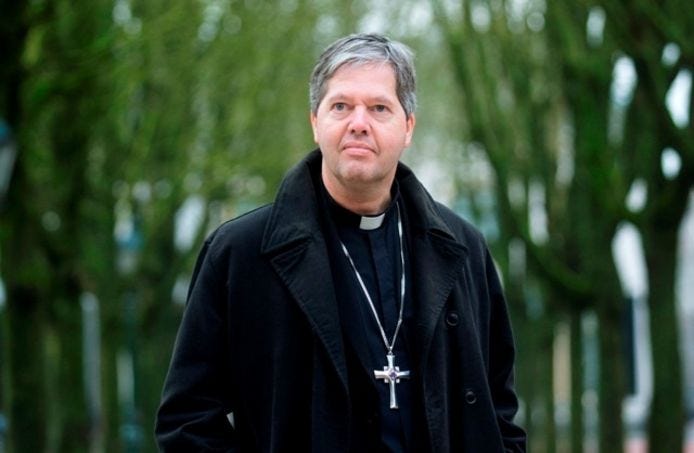
Responding to this, Mutsaerts wrote in defense of clerical celibacy and took issue with Bonny’s argument that married priests are necessary in order to address the decline in clergy numbers.
For Mutsaerts, the question is not simply what is permitted by Canon Law, but the underlying aspect of why the Latin Rite of the Church calls its priests to celibacy. “The question is not only: what is practical?, but also: what principle underlies celibacy?,” Mutsaerts wrote.

Continue Reading on Pelican Plus
The bishop, who since 2010 serves as auxiliary of the Diocese of ’s-Hertogenbosch, has become known in recent years as a vocal advocate of traditional teaching in morality, at a time when many prelates are proposing heterodox interpretations of Catholic belief.
He is not blind to the reality that Belgium, like many places in the Church, is facing a dire shortage of priests and young men entering the seminary. But Mutsaerts cautioned against upending the law and diluting it, in order to lessen the entry requirements for the sacrament of Holy Orders. This concept of lowering standards to ease a perceived burden – a concept also much employed by certain activists in the area of morality – would be a rejection of the “gift” of celibacy, he noted.
“Bishop Bonny wishes to redefine the office for practical reasons,” observed Mutsaerts. “In the Church, the office is never merely a function; it is also a sign that reveals something that cannot be measured by efficiency.”
Pope Paul VI’s encyclical Sacerdotalis Caelibatus states that the law of priestly celibacy – laid out in imitation of Christ’s celibate, full sacerdotal gift of self – “has been guarded by the Church for centuries as a brilliant jewel, and retains its value undiminished even in our time when the outlook of men and the state of the world have undergone such profound changes.”
Mutsaerts further noted how the Second Vatican Council referred to clerical celibacy as a “precious gift” for the Church. For this to be true, Mutsaerts attested that it must remain true, and not simply be a temporary practice of the Church:
“Suppose—a reductio ad absurdum is illuminating here—that the Church were to abandon celibacy because there are too few priests. Then it is effectively saying: What we called a gift yesterday that we had to beg for is today an obstacle that we must eliminate. But if celibacy is a gift, is it logical to abolish it precisely when the gift becomes scarce—like throwing away a rare wine because there are too few bottles?”
If the Church removes celibacy from the priesthood and generally admits married men to Holy Orders, then what – Mutsaerts questioned – would be “the sign of total availability if it no longer coincides with the priest’s state of life?”
Much has been made in recent years of the argument that the Church must meet people where they are – a line which translates to weakening Church teaching in order to appear more attractive. The admittance of the divorced and “re-married” to Holy Communion is one such notable example.
Activists for the married priesthood, and often even female ordination, argue that such developments are needed to adapt to the challenges of current society, to become more equal, and resolve low clergy numbers.
For Mutsaerts, this concept is flawed and does not reflect an understanding of the Church’s nature.
“The Church is not a business with a staffing shortage; she is a mystery with a vocation problem,” he wrote. “And the difference is precisely this: a business solves the shortage by relaxing the conditions, while a mystery sometimes solves the shortage by deepening the meaning. Celibacy is more than an organizational choice.”
Rather than weakening the entrance requirements to Holy Orders, Mutsaerts recommended the Church redouble her efforts to preserve the integrity of the sacrament. “If we truly want to resolve the priest shortage, we must avoid confusing the symptom with the essence,” he wrote. “The question is not only how many priests are desirable, but what kind of priesthood we still dare to be: a ministry that functions, or a sign that speaks.”

I support a married clergy, which existed for 1200 years, is scriptural, and still exists for certain converts. The mafia like clique currently running (and ruining) the church has failed to hold bishops accountable for sexual abuse, particularly of teenage boys, and would hate having straight family-oriented married men in their midst. That's enough for me.