The departure of a flourishing, orthodox community of Franciscans from the U.K. leaves a great hole in the ecclesial make-up, and – according to one seasoned academic – “should be a source of national embarrassment” for the Church in the nation.
As of June 1, 2026 the Marian Franciscans have been dissolved and their departure from the U.K. begun. News of the order’s dissolution came first via Bishop Phillip Egan of the Diocese of Portsmouth, in which the Friars are incardinated.
Further details provided by the Friars note that it had been their decision to request dissolution from Egan, after a community-wide vote on April 27. Egan’s decree was formalized on May 24, and he wrote that he agreed to their request after “serious and careful consideration.”
The Marian Friars were formally known as the Priests of the Association of the Family of Mary Immaculate and St Francis, and had been canonically established in Portsmouth Diocese since 2018, as a Public Association of the Faithful.
The community was born after the split which took place in the Franciscan Friars of the Immaculate (FFI), which happened against the backdrop of many years of Vatican persecution and clampdowns by the Holy See on the thriving order, which was becoming increasingly traditional. For many members of the community, their religious life had seen repeated infringements on their vocational life from the Holy See, including interventions as notable as delaying priestly ordinations by several years due to the Vatican’s discomfort with the young ordinands’ traditional views.
In the U.K., the Marian Friars have lived out their charism of Marian spirituality, poverty, and devotion to the liturgy with great vitality. They led pilgrimages and Marian retreats across the country, while also drawing many faithful to their churches due to the liturgical reverence and unabashed homilies.
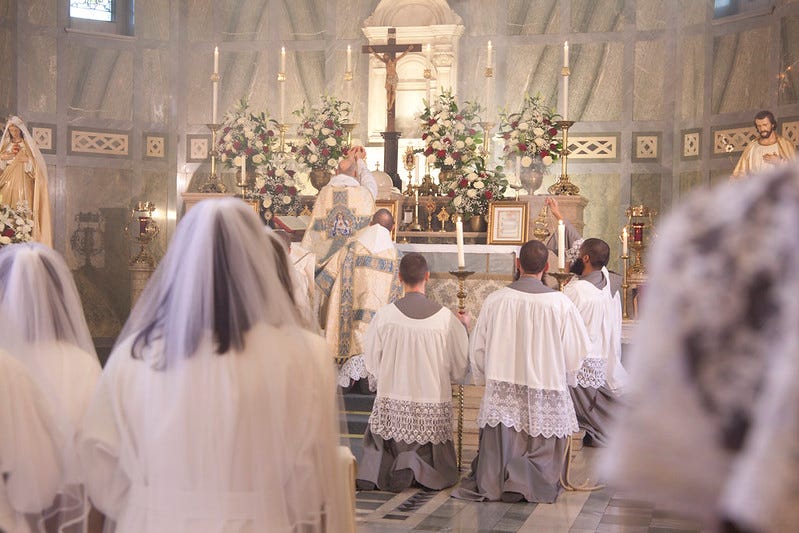
Both the Novus Ordo and the traditional liturgy were offered by the Friars, and it is this aspect which formed a key part of their growth in the U.K. as large numbers of Catholics and new converts have been drawn to the traditional rite in recent years. They also built a large online media network, promoting the Catholic Faith and particularly dealing with issues relating to Marian devotion and theology, along with a publishing house.

After a number of years based solely in Portsmouth, the community expanded to a large, unused campus in Dundee in the territory of the Diocese of Dunkeld.
This base – left almost entirely unused by the diocese prior to their arrival – proved swiftly to be one of great fruit, attracting a number of families to the daily Mass and having plenty of accommodation for the growing number of friars and religious sisters.
However, even here also the Friars faced a turbulent existence. Having been invited by Bishop Robson in 2022, the next ordinary – Bishop McKenzie – ordered the Friars to leave Dundee in February 2025, just a few months after he assumed the see. No further explanation was given by the diocese apart from a statement reading:
“careful consideration with appropriate experts, along with the Council of Priests of the Diocese of Dunkeld, it has been mutually agreed that the Marian Franciscan Sisters and Friars will return to the Diocese of Portsmouth, in which they were constituted and to which they belong.”
The Friars’ previous agreement with the diocese to purchase the Dundee property was thus not ratified, though permission was granted for them to remain in Dundee until October 31, 2026 whilst they searched for a new abode for the large community of friars and sisters. The size of the community has now grown to over 50 in Dundee. According to sources consulted at the time, it had been their hope to remain in Dundee and serve the faithful there from the well-designed lodgings which provided space for the male and female branches of the community.
Such a summary eviction from the Diocese of Dunkeld was the first warning sign of the Friars’ ultimate departure from the U.K. Indeed the Friars’ departure from the U.K.’s shores is a sorry representation of where the Church appears to be in the nation.
According to details issued by the Friars, their decision to leave the country “follows a period of discernment about the long-term future of the community in the UK. Despite growth in numbers and apostolic activity, it was not possible to secure the practical and canonical support needed for formation, sponsorship, and future priestly ordinations.”
It was a decision taken in light of “broader questions about the future viability of the community and its mission in the UK,” they wrote, with “no workable path” being identified for the community in the U.K. without having to alter its character or identity.
Reflecting on this aspect, Dr. Joseph Shaw – chairman of the Latin Mass Society – commented that “the inability of the Church in England and in Scotland to make use of these men should be a source of national embarrassment.”
“The lack of priests in our countries has got to the point that many dioceses are putting up with all sorts of human imperfections to fill gaps in pastoral care,” added Shaw, before praising the Friars for their embodiment of the Catholic Faith.
“It is difficult to avoid the impression, in fact, that it is this very commitment, this zeal, which is the source of their problems,” he opined. “Perhaps I am wrong about that, and I don’t want to be uncharitable to anyone involved. But even the impression, let alone the reality, of this, is a terrible warning sign for the Church in our islands.”
What happens now?
Going forward, as noted by Bp. Egan, the Friars and Sisters hope to join a new community “with a similar charism and in the coming months to relocate.”
This will see the brothers and sisters depart the U.K. but as yet, their future community and location are not able to be confirmed publicly.
Egan has granted permission for some of the priests of the order to remain in the Diocese of Portsmouth during the “period of transition,” and to continue celebrating the sacraments in three churches in the diocese.
He has also granted permission for a slightly amended habit for the community, given that their old habit of light grey-blue with a hood was linked to the now-canonically dissolved order.
Though the Friars are as yet unable to confirm their new location or the order which they will join, their departure will leave a large hole in the ecclesial scene in the U.K. Not least in the area of Marian devotions, which they championed throughout the country and also regularly in the capital city, but also in the traditional Mass scene.
Their base in Dundee provided a rare center for the traditional Mass in Scotland: a country of around 6 million people but which only has regular traditional Masses in the two largest cities of Edinburgh and Glasgow. With that now to be soon vacated, Scotland will be thus bereft of a thriving center for liturgical and sacramental life, which will be particularly felt by the many families who have moved to be within reach of the Dundee church.
But as Dr. Shaw also noted, the Friars’ departure from the U.K. highlights a lamentable aspect of the Church in England, such that it progressively appears that communities, who are forthright in their promulgation of the Faith, are afforded increasingly little welcome.
The Friars preferred not to comment further on the news, when questioned by this correspondent.