

The liturgy is no longer included in the upcoming June consistory, and in its place are the new encyclical, Just War, and updates about the Synodal Assembly of 2028.
A letter sent by Cardinal Giovanni Battista Re (Dean of the College of Cardinals) outlined the plans for the June consistory, which was convened by Pope Leo XIV as a second part to the January consistory after he realized the limitations of the brief time. Revealed by the reliably sourced Messa in Latino, the letter was dated June 3.
The June 26-27 consistory, Re writes, “is intended first and foremost to be a space for mutual listening, discernment, and shared reflection on certain issues relevant to the life and mission of the Church in the present day.” According to the Cardinal Dean, Leo wishes to utilize the “experience and counsel of the members of the College of Cardinals,” whilst also looking for the “active help and support of each one in the various places and responsibilities where they serve the Church.”
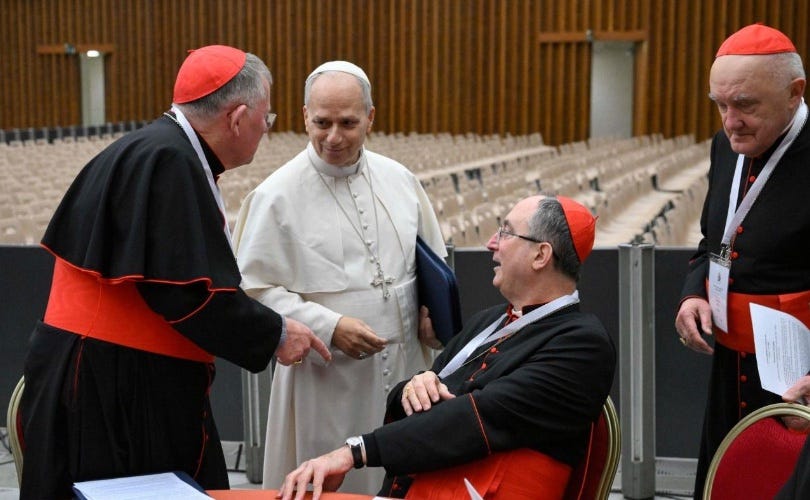
Accordingly, the consistory must be held in “an atmosphere of listening, freedom, and parrhesia, so as to foster a shared discernment on the issues we will be called to address.” This line, though diplomatically written, outlines a subtle warning to the cardinals that no controversy is desired at the consistory: whether that be through promoting heterodox talking points such as the female diaconate or raising doctrinal concerns about the Synod or restrictions on the traditional Mass.
The liturgy was one of four options for the cardinals to discuss in January, and when they did not select it at the time the assumption was that it would be addressed in June. Now it seems as though Leo is under no especial desire to look at it with the college at all – it has been completely removed from the schedule.
In order to ensure the discussion aligns with Leo’s agenda, Cdl. Re presented the themes for each of the four sessions of the two-day consistory.
First is “a shared meditation beginning with the international situation,” during which the cardinals will be asked to “share” the concerns and priorities which emerge from their respective areas of the globe. It will be guided by two formalized questions: “What sufferings, tensions, and questions are most acutely affecting the peoples and ecclesial communities entrusted to His care today? What signs of hope, of fidelity to the Gospel, and of possible reconciliation do you feel it is important to bring to our shared listening?”
This somewhat vague opening session will be followed swiftly by two sessions – second and third – dedicated to the recently released encyclical Magnifica Humanitas.

Members of the College will be asked to read paragraphs 182 - 192 of the text, examining how – in light of growing global conflict – “peace is not just one issue among others, but a condition of the universal common good and a test of the moral maturity of peoples.” Notably, the College is tasked with looking at the topic of the Just War, after Leo commented in the encyclical that it is “outdated.” They will address:
how to reaffirm today “the rejection of the theory of the ‘just war,’ which is all too often invoked to justify any war” (no. 192) and on what concrete paths can help peoples and Christian communities to safeguard and build peace.
With this passage it becomes more apparent that Leo’s comments regarding the Just War Doctrine are not limited to labelling it as outdated, but tend more to the view that no conflict can be deemed just in modern society.
Continuing Magnifica Humanitas in the consistory, the cardinals will devote the third session to ‘building in the good,” by which they dwell on the encyclical’s “call to interpret the transformations of our time in the light of the Gospel and to direct the human desire for happiness and fulfillment toward integral human development.”
Finally, the last session of the consistory will be devoted to the Synod once more. According to Cdl. Re, the cardinals will be updated on the “process of implementing the Synod,” taking into account the newly released document by the Synod Secretariat which outlines the path towards the 2028 Synodal Assembly.

Only at this point, will the College of Cardinals be granted a time of free interventions between themselves and the Pope, limiting their remarks to three minutes each. Such free interventions used to form the bulk of consistories, and many cardinals have lamented how this format has been done away with: first by Pope Francis not holding a consistory since 2014, then by meeting with the cardinals next in 2022 at which point the free interventions had been done away with.
By the time Leo’s first consistory was held in January of this year, it appears that the traditional organizational method of the consistories was firmly put aside in favor of the Synod-style discussion tables.

Interviewed by this correspondent in February, Cardinal Gerhard Müller expressed his concern at the round-table method employed at Leo’s first consistory. “I think this was an experiment promoted by those who organized it with more illogical ideas,” Müller opined. While he noted that in the small groups cardinals could “speak openly,” he added that “at the end there no result for the others and therefore everybody would prefer the plenary discussion.”
The current situation, lamented Müller, is “not so adequate to the consistory.” Indeed one weighty aspect is that only a small minority of the cardinals were afforded the chance to speak, due to the excessive time devoted to the small group discussions – dubbed “superfluous” discussions by Müller.
Indeed, as reported by Pelican+ at the time, the handiwork of the General Secretariat of the Synod was very much on display in January’s consistory, raising concerns for all those who were worried about the Synod itself.
Since then, Vaticanist Diane Montagna has also highlighted how the traditional consistory style was rejected in favor of a more “synodal” method. Questions about who exactly was behind this move went notably unanswered, suggesting a deliberate move by some key figures to ensure that the Synodal process continues at every stage of the Church.
The consistory will thus be held in line with the above agenda on June 26 and 27, while cardinals will join the Pope for the festal Mass of June 29.
We have an impending declaration of excommunication for the SSPX, congregations such as the monks of Papa Stronsey deciding to cut ties with Rome, and countless regular TLM-going Catholics booted from their parishes because of the unjust, bigoted *Traditiones Custodes* — and Rome decides once again that the liturgy wars are just a peripheral issue leadership is far too busy to examine?
The Church today is run by men who are either evil, stupid, or simply unserious. Or a combination of all three.
Liturgy kicked to the curb again. Who didn’t see that coming?
Synodality Rules! Liturgy? Meh.
Catholics need not apply.