

Leo XIV welcomed Sarah Mullally to the Vatican for a private meeting and joint prayer this morning, before the Church of England archbishopess presided over Anglican Evensong in one of Rome’s ancient Catholic churches this afternoon.
The appointment of Sarah Mullally as the first female Archbishop of Canterbury in the Anglican church has caused as much consternation internally as it has further afield in the Catholic Church. The Church of England is increasingly pursuing a course of action that is only fueling the widening global civil war, over issues such as homosexuality and female orders. But in doing so, it is also deepening the divide which exists between Lambeth Palace and the Holy See.
A casual observer of Mullally’s four-day visit to Rome and the Vatican this weekend, would perhaps be surprised that such a divide exists, given the notable warmth of the reception which she was awarded.
Mullally was certainly extended every courtesy. She received a VIP visit to the public and private areas of the four Papal basilicas around Rome and a private tour of the Vatican museums.
On Monday morning she met privately with Leo XIV, before joining him for midday prayer in the Urban VIII chapel inside the Apostolic Palace.
“The purpose of the visit is to strengthen Anglican–Roman Catholic relations through prayer, personal encounter, and formal theological dialogue,” Mullally’s office declares. “It aims to deepen bonds of communion, affirm a shared witness, and encourage ongoing collaboration at both global and local levels.”
Arguably the most controversial moment was on Monday afternoon when she presided over the Anglican service of Choral Evensong held inside the Catholic church of Sant’Ignazio di Loyola. During the ceremony she formally commissioned her representative in Rome, Bishop Anthony Ball, as Cardinal Luis Antonio Tagle – Pro-Prefect of the Dicastery for Evangelisation – delivered the homily.
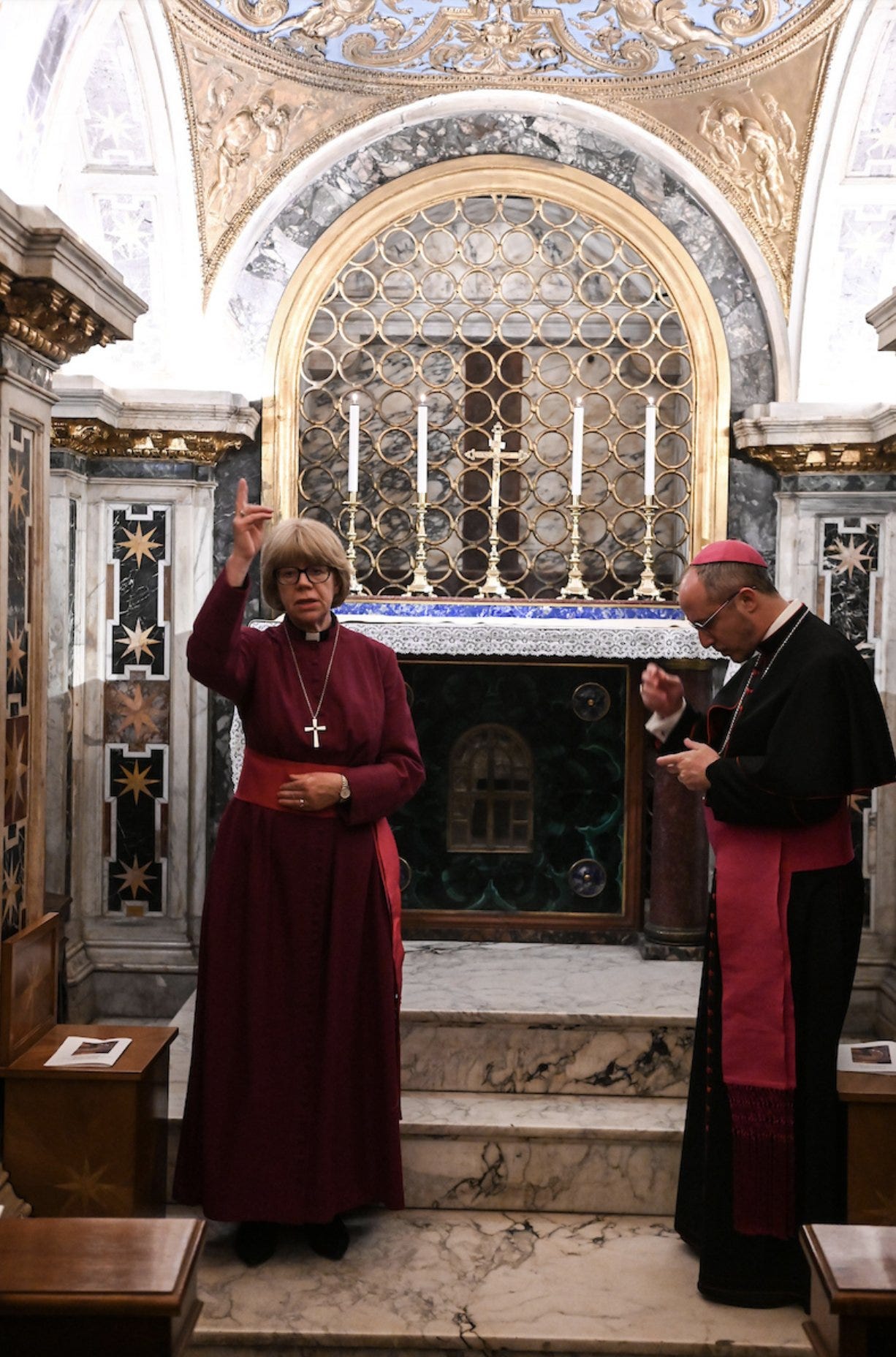
But it was pre-empted by a video clip shared by Mullally online, in which the secretary for the Dicastery for Christian Unity was seen blessing himself while Mullally delivered a blessing in the Petrine Chapel, situated right next to St. Peter’s relics. Many opined that Archbishop Flavio Pace’s actions were severely misguided, given the fact that the Catholic Church does not recognize the validity of Protestant orders.
In 1896, Pope Leo XIII issued Apostolicæ Curæ in which he succinctly stated that “we pronounce and declare that ordinations carried out according to the Anglican rite have been, and are, absolutely null and utterly void.” This teaching remains unchanged for the Holy See.
Such an element was likely what Leo XIV was referring to during his formal address to Mullally, the text of which was published – a rare event for a private meeting. The “ecumenical journey” of Catholics and Anglicans has been “complex,” said Leo.
Echoing the text of his message sent to Mullally for her inauguration, Leo added that
“while much progress has been made on some historically divisive issues, new problems have arisen in recent decades, rendering the pathway to full communion more difficult to discern.”
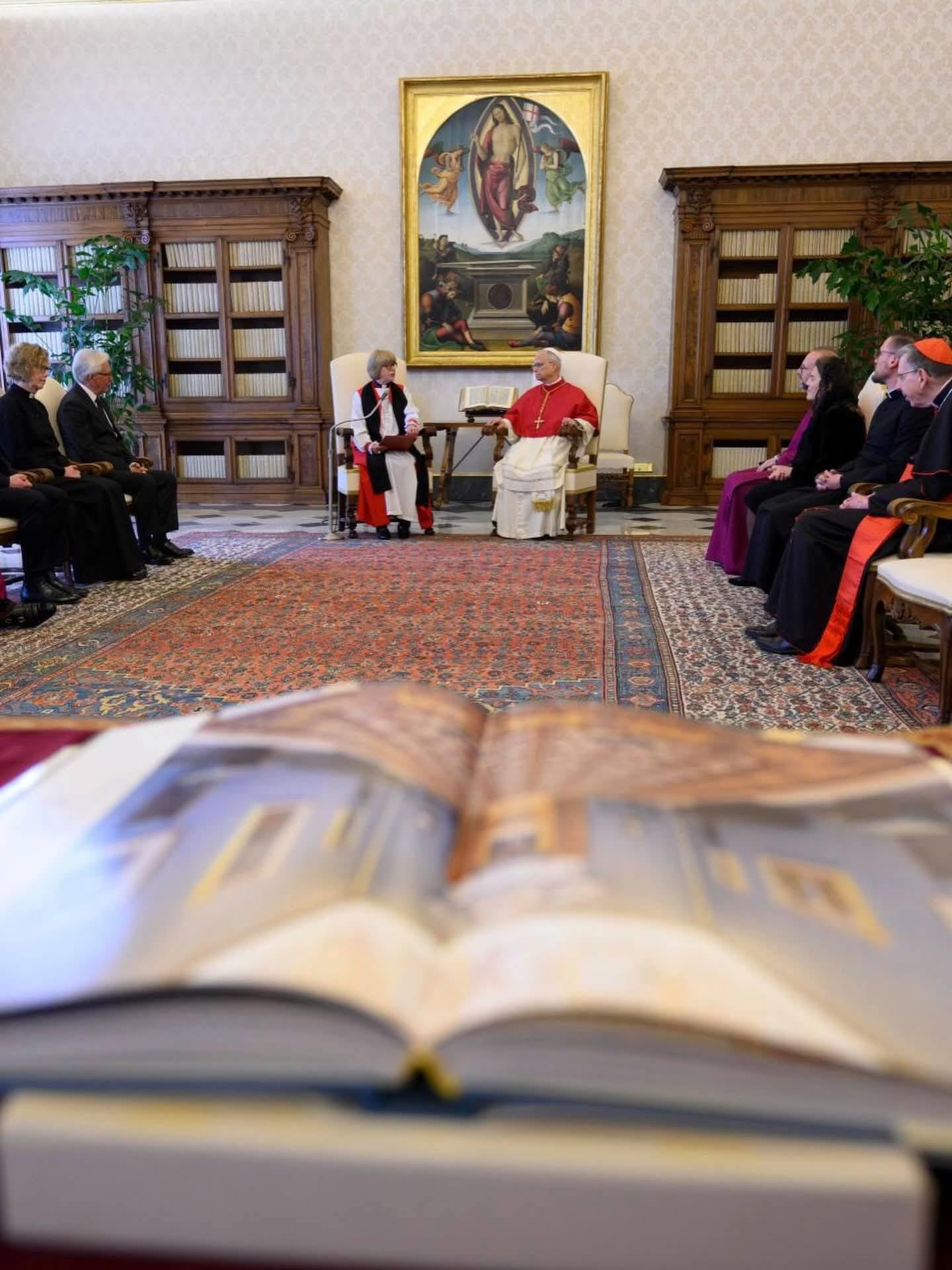
But he opined that such “continuing challenges” should not hinder the joint action of “proclaim[ing] Christ together.”
“As we continue to journey together in friendship and dialogue,” added the pontiff, “let us pray that the Holy Spirit, whom the Lord breathed on the disciples on the evening after his resurrection, will guide our steps as we prayerfully and humbly seek the unity which is the Lord’s will for all his disciples.”
For her part, Mullally told Leo that “I will remain united with the Pope in prayer – for peace in our world, for justice, and for every person to discover the fullness of life that God offers.”
“May we continue to walk together in that hope, trusting that the one who has begun this good work among us will bring it to completion,” she added.
The Catholic Church’s approach to ecumenism has changed notably in recent decades. Referring to the Church’s relationship with other religions, Pope Leo XIII wrote in his 1888 encyclical Libertas that the Catholic Church “tolerates certain modern liberties, not because she prefers them in themselves but because she judges it expedient to permit them, she would in happier times exercise her own liberty; and, by persuasion, exhortation, and entreaty would endeavor, as she is bound, to fulfill the duty assigned to her by God of providing for the eternal salvation of mankind.”
The Church’s ecumenical mission must involve drawing others to the fullness of the truth. Indeed, Pope Benedict XVI affirmed this teaching in a 2010 address, in which he stated: “The witness of charity, practised here in a special way, is part of the Church’s mission, together with the proclamation of the truth of the Gospel.”
In recent years dialogue has often taken place in a spirit which has seemed to emphasize unity at the lowest common level, and though external relations have become warm, the actual possibility of large-scale Anglican conversions to Catholicism slowed after the initial spurt during the establishment of the Ordinariate.
Particularly under Pope Francis, the relationship with the Anglicans took a high profile, as he embarked on a number of ecumenical and interreligious ventures. Yet at the same time, the Anglicans have moved forward doctrinally in such a way that the Church of England is further adrift from the Holy See than it had been previously.
Reactions to the Holy See’s warm welcome of Mullally have been divided. Some in England view it as part of a natural diplomatic move, while those in America have tended to condemn the Vatican’s actions strongly.
What seems undeniable is that despite the many years of Catholic-Anglican ecumenical dialogue, by very fact of having approved female ordination the Church of England has clearly no immediate intention of aligning itself with Rome and the See of Peter.
Connect with the author on Pelican+ Social


I suppose the Pope felt that it wouldn’t hurt to be polite to the High Priestess of the Church of England. Whatever. And perhaps that other guy was invoking a real blessing to counteract her fake one. One would hope so.
The confusion caused by this and other actions of LIV is abominable and will undoubtedly be the cause of the loss of many souls who will think that because he is "the pope," that what he does is "ok"...
Our Lord Jesus Christ founded ONE Church, holy and apostolic outside of Which there is no salvation - stated as dogmatic teaching - 3 times! Our Lord prayed on the night before He died that all believers would be one, as He and His Father are One. The New Testament is FULL of accounts of St Paul and the others constantly clearing up heresies and divisions with the ONE TRUTH. Pope Leo's predecessor made it clear that Anglican orders are, basically, NOTHING.
WHAT ARE THESE LAST TWO POPES UP TO???