Saints are sometimes associated with a grim, austere manner and an ascetic, even forbidding personality. What a merry time St. Philip of Neri would have had contradicting those associations. Even the German Freemason Goethe loved Philip of Neri, informally known as “the happy saint.”
Beyond his kindness, sense of humor, and general likability, Philip’s life was the stuff of miracles and legends. The most famous miracle concerned Philip’s immense love for God and mankind causing his heart to become permanently dilated, so large it almost burst through his skin. More on this – and other miracles - later.
Even before his cardiac adventures Philip was a happy soul. Born on 22 July, 1515, he was one of four children born to a Florentine couple. Although Philip’s mother and brother died early on, he absorbed these losses and was invariably a pleasant and kind boy. He attracted other children to him, and charmed adults. His two sisters gave him the nickname “Pepo Buono”, or good Philip.
Philip studied the humanities under the tutelage of Florentine scholars. At age sixteen he was sent to San Germano to learn the business his cousin was running. Although Philip found business boring, he applied himself and won the trust of his cousin. Whenever he could Philip withdrew for prayer to a Benedictine mountain chapel in nearby Monte Cassino.
Legend has it that one night Philip was laying in bed counting abacus beads in his head when the host of heaven descended upon him and made his vocation clear: he was to be an Apostle to Rome. The next day Philip left San Germano and walked, penniless and with only the shirt on his back, to Rome. After a trek of eighty miles he arrived: hungry, thirsty, dusty, and sore.
Providence intervened in the form of Galeotto Caccia, a native Florentine who gave Pepo Buono a hard floored attic room and daily bread in return for Philip tutoring Galeotto’s children. In his spare time he studied philosophy and theology at the school of the Augustinians. Years later many were amazed that beneath his jovial exterior Philip possessed an intimate knowledge of complex theological subjects.
After two years as an attic recluse Philip abruptly began his public life ministering to the Romans. At the time the city had not recovered from the destruction of invading armies. Churches were destroyed, half ruined, or half repaired. The clergy were in a similar condition. Hardship and exhaustion reigned. What could be done?
The most unlikely answer to that question was Pepo Buono himself: a skinny, bearded vagabond who slept in churches and carried his food in the hood of his cloak. He liked to pray in the catacombs, then swoop out to accost people in the streets with a huge grin. His happy personality, lively faith, and sincere interest in everyone he talked to were conceded even by those who shunned him.
Philip often walked up to Romans with the question: “Brothers, when shall we begin to do good?” Although answers to this question varied, Philip listened to everyone without judgment, sympathized with their plights, and encouraged their good impulses. When people expressed a wish to do good, Philip took them directly to hospitals to care for the sick, or to church to pray. After everyone left Philip dwelt in solitude, often in the catacombs, pondering tomorrow’s missions.
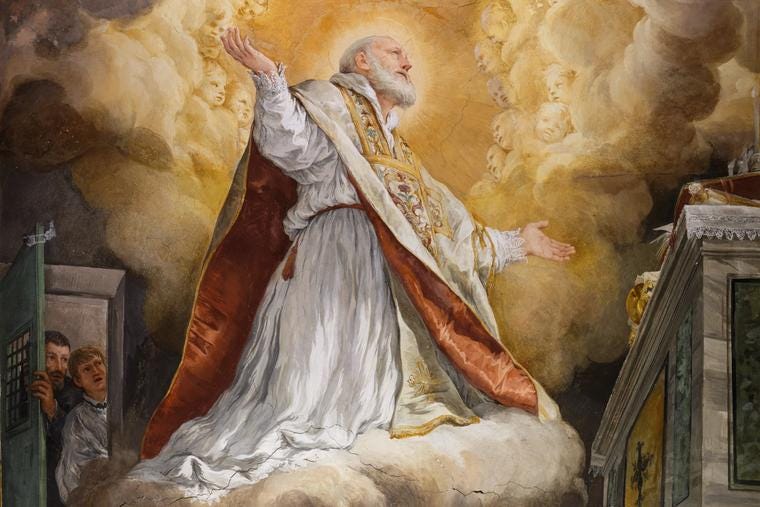
Philip’s Heart
The miracle of Philip’s heart happened in 1544. Once more, heaven visited Pepo Buono in the evening (some say Pentecost Eve), this time in the form of a descending globe of fire - like the tongues of fire said to have descended upon the apostles on Pentecost. The globe entered Philip through his mouth. He immediately felt an overwhelming dilation of his heart, and the increased joys and ecstasies a larger heart would be able to bear. Philip fell, groaning “Enough, enough, Lord, I can bear no more!”
After ecstasy he lay like a broken man. Gradually coming to himself, he saw a protrusion in his chest the size of a normal man’s fist, but in the shape of a heart. Strangely, there was no pain or discomfort, even when the protrusion violently palpitated, as it frequently did when Philip was communing with God or performing spiritual works of mercy.
Philip’s enlarged heart was well known. Many attested to actually seeing and feeling Philip’s heart pulsating under his clothing while he hugged them. From the time of the miracle until his death Philip’s heart palpitated when he performed any spiritual action.
Centuries after his death some argue Philip’s enlarged heart resulted from an aneurysm. This doesn’t square with numerous testimonies about the forceful heart palpitations noticed during Philip’s habit of pressing penitents to his breast to comfort or absolve them. The Abbate Crescenzi “felt Philip’s heart beating with so great a force that it seemed to him to be on the point of leaping from his breast.”
Some doctors treated Philip with bleedings and hot irons. He dismissed them as “dullards,” a curiously appropriate term for a few current medical minds as well...