

Satanism During the Cristero War
By: Phillip Campbell
Editor’s disclaimer: This article contains historical accounts of sacrilege, blasphemy, and violence that some readers may find disturbing. These details are included not for shock value but because the full weight of the cause of the Cristeros demands an honest assessment of the times in which they lived. The following is a clear demonstration of where ideology that dethrones Christ the King leads.
The Cristiada, or Cristero War (1926–1929), was a widespread armed rebellion in central-western Mexico against the anticlerical policies of President Plutarco Elías Calles, who had attempted to subvert the Church’s role in Mexican society with a series of laws aimed at curtailing the religious liberties of Catholics. Those faithful Catholics who fought back against the tyranny of Calles were known as Cristeros, from their battle cry, “¡Viva Cristo Rey!”, “Long live Christ the king!” The bloody conflict would give the Church several dozen saints and blessed who endured martyrdom for the faith, most notably the priest Bl. Miguel Pro, S.J. (d. 1927) and the boy-martyr St. José Luis Sánchez del Río (d. 1928).
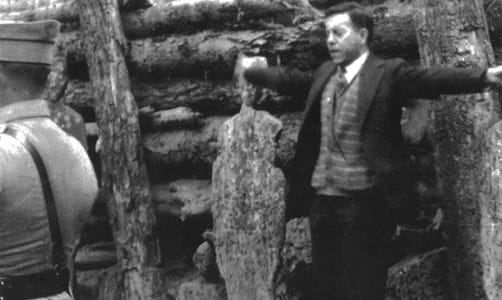
The virulent hostility of the Calles government to the Catholic Church is well-known and needs no elaboration. In this essay, we will focus instead on a lesser-known aspect of the conflict, what we might call the diabolical or satanic character of the Calles government’s attacks on the Church. For while the Calles persecution was inflicted under the guise of progress and secularization, a study of the records reveals a darker dimension to the conflict. Time and again we see the attacks of federal troops were motivated not merely from a desire to enforce the law of the land, but from a bitter hatred of the Catholic religion. This hatred was often manifested in displays of blasphemy that seem positively diabolical in their malice. This is, what I would call, a demonstration of the satanic nature of the Calles persecution, whose agents went out of the way to mock, blaspheme, and denigrate the Catholic faith with demonic sadism.
In Jean Meyer’s 1974 three-volume history of the Cristiada, we hear of federal soldiers making mockery of the Christian religion by inverting Christian symbols and gestures in ways reminiscent of satanic rituals. Meyer calls this farce the “world upside down” mentality. Meyer recounts soldiers deliberately putting on liturgical vestments backwards, holding holy books upside down, and pretending to read them while reading opaque glasses. They even mimicked the gestures of the Mass backwards as a sign of ridicule (which, ironically in 1927, would have meant versus populum).1 This is what is commonly known as ritual inversion, the reversal of traditional Catholic gestures for the purposes of mockery or robbing them of their efficacy. Late medieval books on witchcraft such as the Malleus Maleficarum (1486), De Superstitionibus (1450) accused medieval witches of these very inversions. It is not relevant whether such things really occurred during the Middle Ages; the point is the federales knew that ritual inversion was considered a satanic mockery of the faith and deliberately engaged in it with full knowledge of its symbolic weight.

