Medieval people possessed a deeply symbolic view of reality that moderns find difficult to comprehend. This is especially notable in Sacred Scripture. Most Catholics are well aware of the “typological” method of reading the Bible, where Old Testament events symbolically prefigure New Testament realities—and the Sacred Liturgy, of course, provided a rich garden of symbols for contemplation, as we find explained in medieval liturgical commentaries, such as William Durandus’s Rationale Divinorum Officiorum.
Medieval symbolism went far beyond the Bible and the liturgy, however. For the medieval, every aspect of the world was pregnant with a deep symbolic meaning, attesting to the truths of the faith. Author Celia Fisher, for example, has documented over 100 symbolic meanings for flowers listed in medieval texts, representing concepts like wisdom, fertility, or piety (check out her Medieval Flower Book for a fascinating deep dive into medieval floral symbology). Medieval naturalists compiled books called lapidaries, which explained the properties and symbolic meanings of gems, stones, and minerals. Another genre of text was the bestiary, an illustrated compendium of animals blending natural philosophy with Christian allegory.
The Bodleian Library in Oxford preserves one of best examples of a medieval bestiary. MS 764 (hereafter the Bodleian Bestiary) is a vellum text of 140 lavishly illustrated folio pages created in England during the mid-13th century. The original Latin text has been translated into English and the entire work published in book form by the Folio Society, giving us access into the colorful world of animal symbology in the high Middle Ages.
Today we will be looking at six animals that represent our Lord, according to Bodleian Bestiary. We are already familiar with certain biblical images associated with Christ—for example, the lion and the lamb. The Bodleian Bestiary goes much further, however, presenting us with a rich panoply of creatures said to symbolize our Lord, some of them quite counterintuitive. For those reading (as opposed to listening) you will be able to see the original illustrations from the manuscript for each animal.
Cow
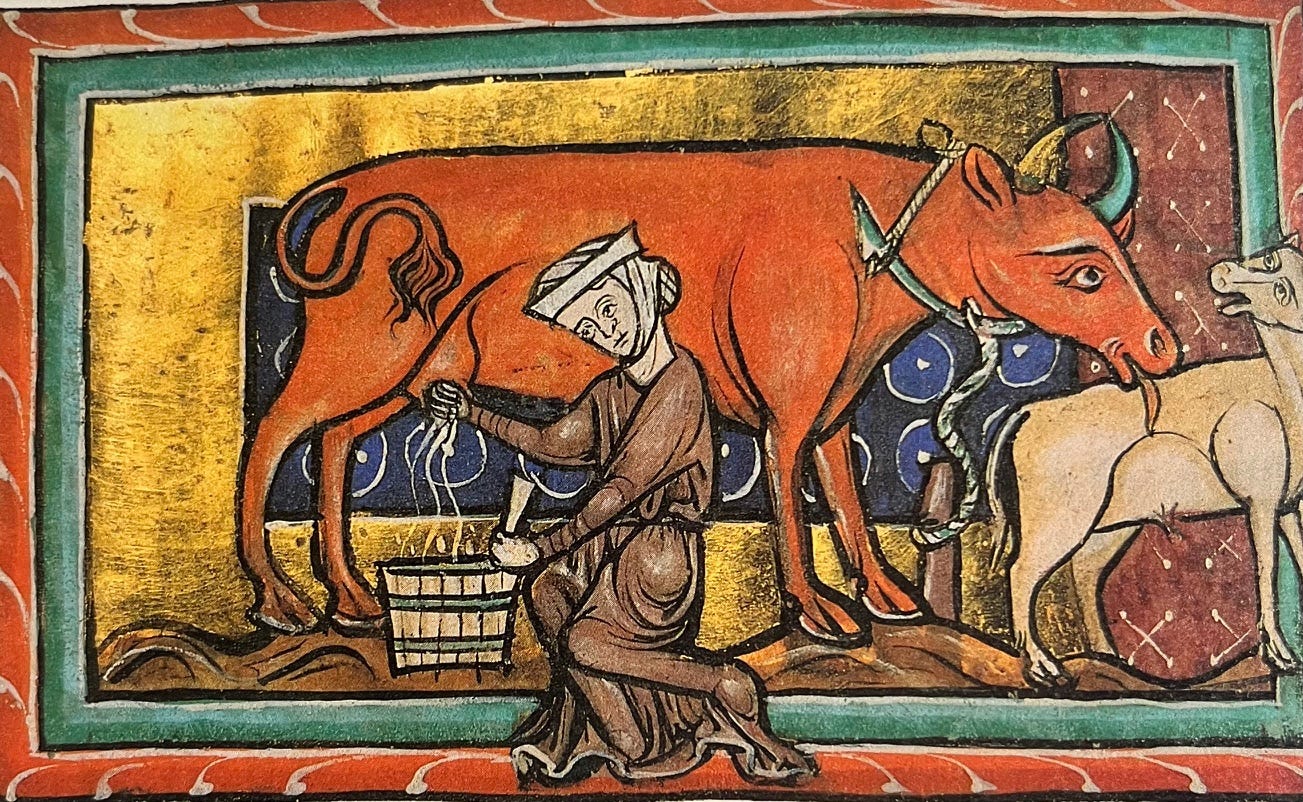
One of the most common animals that represents our Lord is the cow. The Bodleian Bestiary makes a distinction between the symbolic value of males and females. It says that the cow represents the Lord in His human weakness, especially His passion:
The male usually represents strength, the female weakness. This is the case of the cow, which stands for the sacrifice of the Lord’s incarnation in His weakness, of which it is written, “For though He was crucified through weakness, yet He liveth by the power of God” [II Cor. 13:4]. He is called a red heifer because His human form was made red by the blood of the passion. His humanity is without blemish, all His deeds perfect; there was no spot on His human form.[1]
The Bodleian Bestiary also notes that a calf can also symbolize Christ, as Christ is the “fatted calf” that is slain in the parable of the Prodigal Son, as well as the calf which skips mentioned in the Psalms (cf. Luke 15:23, Ps. 26:9).[2] This depends on context, however, for it also says that calves sometimes represent “the lascivious Jews” as well.[3]