

Scholars of St. Francis of Assisi have frequently noted the deep Trinitarian nature of Francis’s spirituality. Themes on the Trinity can be found throughout the writings of the Poverello. His form of life given to St. Clare and her sisters, for example, presents the spiritual life as a beautiful invitation to join the Triune life of God. Wherever we look in the Franciscan corpus, we see the Christian life described in terms that are familial and Trinitarian: the vocation to be a child of the heavenly Father, to consider others as brothers and sisters in Christ, holy women as spouses of Christ, and all believers as homes wherein the Holy Spirit deigns to dwell.
Francis’s Trinitarian vision extended beyond his writings to his very manner of living. The Franciscan scholars Regis Armstrong and Ignatius Brady, in their 1982 commentary on the writings of Francis, state:
Traditionally, Franciscan spiritual writers have identified the approach of St. Francis as Christocentric. In this Francis was no different from other Christians. What is unique in his writings, however, is his intuition of the penetrating character of the Trinitarian life in the daily living of the Christian faith.[1]
In other words, Francis’s writing on the Trinity was never just a point of theology. Rather, it was the expression of a profound conviction that Christian life must be treated as a participation in the life of the Trinity. This is evident from the outset of his vocation; in his dramatic confrontation with his father before the Bishop of Assisi, he cried, “From now on I can freely say ‘Our Father who art in heaven,’ not father Peter Bernardone.”[2] The entire way of life modeled by Francis is nothing other than maintaining a loving relationship with the Father through imitation of the Son in the power of the Spirit.
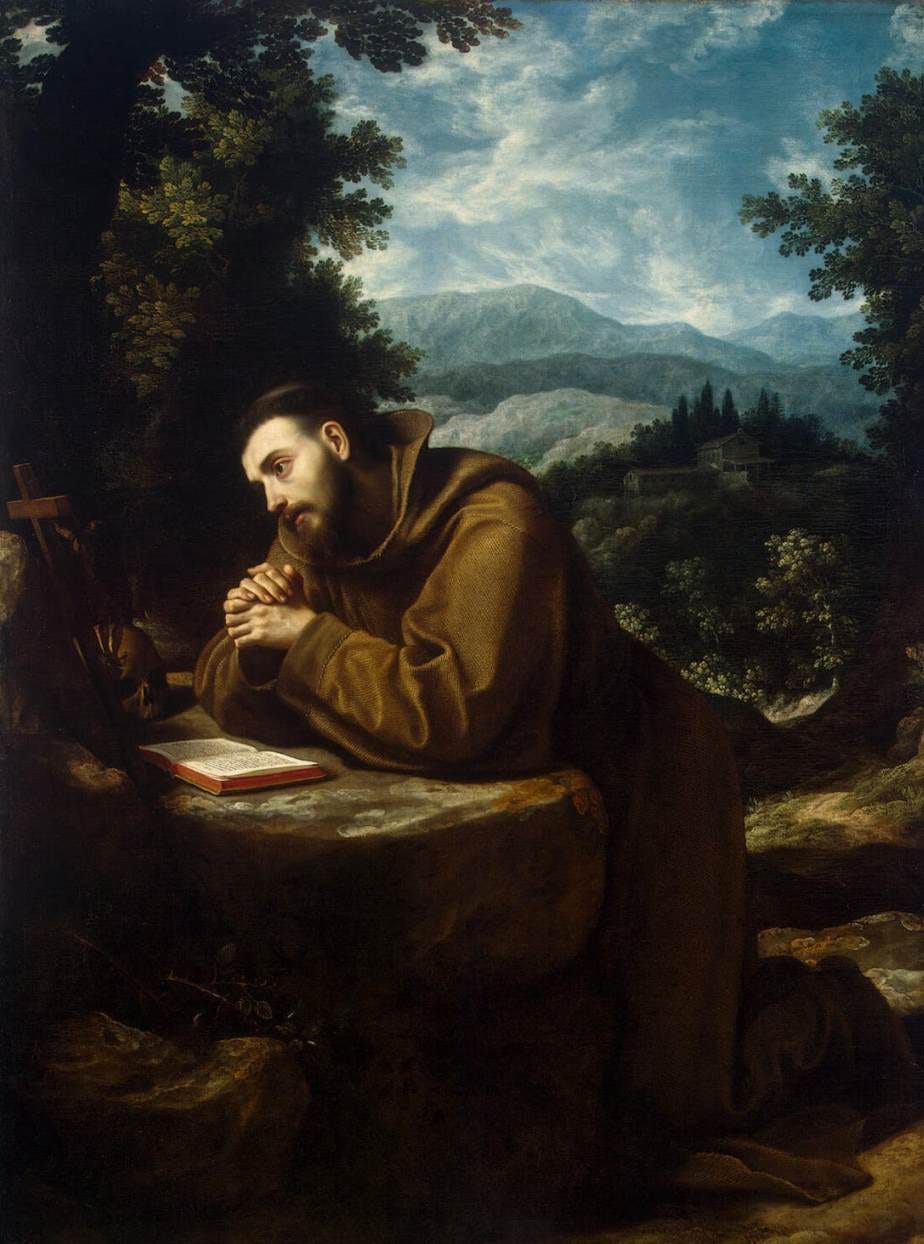
Francis imbued the early Franciscan order with the same vision. This is reflected in his devotion to the Our Father, which he considered the supreme prayer and ultimate reflection of a Christian’s Trinitarian orientation. The Our Father shows up all over the writings of Francis. Thomas of Celano said that the lessons on prayer that Francis gave his followers were entirely centered on the Our Father.[3] Francis’s Second Letter to the Faithful admonished readers “let us praise Him and pray to Him day and night, saying ‘Our Father who art in heaven,’ since we ought to always pray and never lose heart.”[4] His earlier rule of 1221 prescribed the Our Father to be said as penance for minor offenses, and he directed his brothers to preface the Little Office of the Blessed Virgin with a devout recitation of the Our Father. Francis’s later rule of 1223—the one approved by Pope Honorius III—shows more than anything the central place Francis attributed to this prayer in his community. Chapter 3 of the Rule of 1223 mandates the following for his lay followers:
The lay brothers are to say twenty-four Our Fathers for Matins and five for Lauds; for Prime, Terce, Sext, and None, for each of these, they are to say seven; for Vespers twelve and for Compline seven. They should also say some prayers for the dead.[5]
This amounts to a completely alternative Divine Office —an entire liturgical day structured around repetitions of the Lord’s Prayer, designed for brothers who could not read. If we do the math—24 + 5 + (7×4) + 12 + 7—this comes to 76 Our Fathers daily for lay brothers. This makes the Our Father the single most practically important prayer in the life of the Franciscan lay brother, the backbone of his entire prayer life.
It is also worth noting that the 1883 Rule for Franciscan Tertiaries approved by Leo XIII also assigns a special place to the Our Father in the life of the Tertiary. Chapter 2, No. 6 says:
Tertiaries among the clergy, since they recite the Divine Office daily, shall be under no further obligation in this regard. Lay members who recite neither the Canonical Hours, nor the Little Office of the Blessed Virgin Mary, shall say daily twelve Our Fathers, Hail Marys, and Glorys, unless they are prevented by ill health.[6]
In the Franciscan family this is known as the Office of the Paters (if you’d like to take a look at the Office of the Paters, there is a full PDF of it available online here).
Given Francis’s deep devotion to the Our Father, it is not surprising that the saint composed his own exegesis on the prayer. This text goes by several names—its Latin is Expositio in Pater Noster, “Exposition on the Lord’s Prayer,” but it is also known as the “Prayer Inspired by the Our Father.” That the textual tradition considers this both a “prayer” and an “exposition” speaks to Francis’s manner of weaving prayer and teaching together in a single tapestry of praise. Let us examine the saint’s commentary on our Lord’s Prayer to better understand how it informed his spirituality. We will consider the text one passage at a time, using the 1905 English translation by the Irish Franciscan Paschal Robinson.[7] In classic exegetical fashion, Francis goes through the prayer line by line, offering his commentary after each clause.


