Across the medieval Christian West, the act of viewing the consecrated host carried enormous spiritual weight. England offers a particularly rich set of examples centered on the moment of elevation after the consecration of the Eucharist. This article draws on English sources to explore how central the sight of the host was to medieval devotional life, and how reluctant the English were to abandon this long-hallowed custom.
The elevation looked very similar then as it does today: After pronouncing the words of consecration over the bread, the priest venerated the host, took it from the paten, and held it aloft for the veneration of the people. This was called the ‘first sacring.’[1] The word sacring comes from the French sacrer and Latin sacrare, “to make holy.” As today, hand bells were rung to draw the congregants’ attention to the mystery unfolding upon the altar (these were known as ‘sacring bells’). Those present were expected to make a deep bow; in the mid-thirteenth century, the Bishop of Ely, directed that “every priest should teach his people frequently that when the health-giving host is held up, they should all bow reverently.”[2]
The church bells were also rung; those who heard from outside were expected to kneel. The 1281 Council of London stipulated that bells be rung at the moment of the elevation “so that the people might bend the knee wherever they were, in the fields or their houses.”[3] Interestingly enough, it seems that some priests were in the habit of kissing the consecrated host at this point, though the practice was not universal and appears to have been somewhat controversial—the 14th century English cleric John Mirk in his Manuale Sacerdotis (“Instruction for Parish Priests”) notes the prevalence of the practice but considers it inappropriate.[4]
After the consecration of the wine, the priest bowed, kissed the altar, and then lifted the chalice and host above his head together, which was known as the ‘second sacring.’ This elevation was once considered the climax of the Mass, but by 1200 the people’s focus had shifted to the first sacring as the pivotal moment—at least in England.

So much for the ritual act itself, which most Catholics will easily recognize from our own liturgies today. But in this article we are not so much interested in the liturgical action as the piety of the people, for the moment of elevation held a place of unique importance in the devotion of the medieval worshiper.
Let’s first talk a bit about the architecture of medieval churches, which, as we shall see, could make or break a worshipper’s experience of the elevation.
In medieval churches, the chancel was set apart from the nave by some kind of physical partition. Generally this would be a rood screen, an ornate, typically openwork partition made of wood. Some of the best-preserved rood screens today can be seen in England, whose churches have generally held up better than their continental counterparts. Though the rood screen was most common, churches on both the poorer and wealthier ends of the spectrum might have recourse to other types of partitions—curtains might be hung between columns (the templon arrangement), while in cathedrals and larger churches the chancel might be set apart by walls of solid stone.[5] In Canterbury Cathedral, the chancel is divided from the nave by a gargantuan stone wall called a pulpitum, decorated with ornate carvings depicting the monarchs of England.[6]
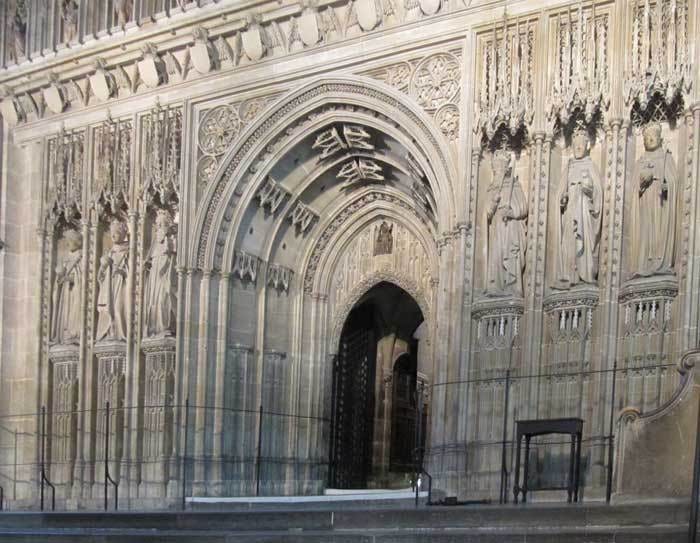
While necessary to set apart the parts of the church reserved just for the clergy, these screens and walls could occasionally hinder the visibility of the congregation. This was especially frustrating when it came to the elevation, which was precisely the moment of the Mass people were most eager to witness. It is well-known that people in the Middle Ages received communion far less frequently than Catholics today, sometimes only once or twice a year. Witnessing the elevation was therefore one of their primary acts of engagement with the liturgy. Beside the ritually-prescribed bow, other acts of private devotion were encouraged; among these, gazing took preeminence. Gazing upon the Blessed Sacrament was known as “seeing God” or “seeing one’s Maker” and was believed to confer innumerable spiritual benefits upon the pious worshipper.[7] John Mirk’s Instruction for Parish Priests promises all manner of blessings for those who “see God’s body,” both temporal and spiritual:
Fair weather or foul, let them not hesitate
To worship him who made all things;
For glad may that man be
Who once in the day may see him;
For so much good does that sight
(as Saint Augustine rightly teaches)
That on the day that you see God’s body,
These benefits you shall surely have:
Food and drink at your need
Shall not be begrudged you that day;
Idle oaths and words also
God forgives you both;
Sudden death that same day
You need not fear, without doubt;
Also that day I pledge you
You shall not lose your eyesight;
And every step that you take then,
To see that holy sight,
They shall be counted to stand in stead
When you have need of them.[8]