

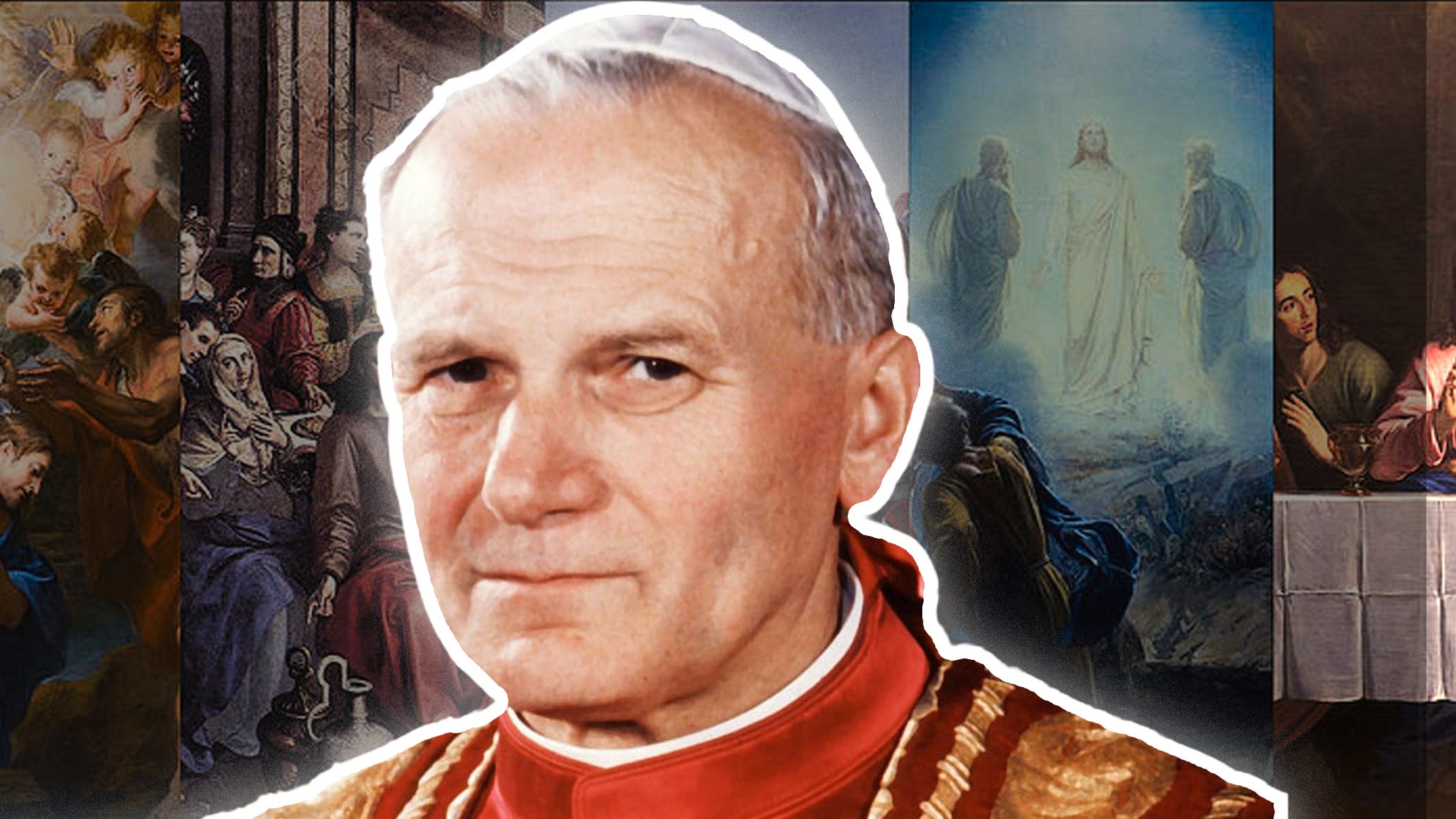
It is hard to believe that it has already been twenty-three years since Pope John Paul II’s Rosarium Virginis Mariae, the 2002 Apostolic Letter on the Rosary that gave us the Luminous Mysteries. The so-called “Mysteries of Light” were proposed by John Paul II to promote his Year of the Rosary (2002-2003). Today we will revisit these mysteries in light of the two decades since their addition and offer what might be called a mature Trad reflection on the matter.
First, some essential background:
The Apostolic Letter Rosarium Virginis Mariae was intended to reinvigorate Catholic interest in the Rosary at the dawn of the Third Millennium. It is well-known that private devotions of all kinds went into sharp decline after Vatican II, as Church leaders insisted that all devotion needed to happen in a communal setting. The Rosary was one such casualty. The drop off was catastrophic. As early as 1974, Paul VI was already speaking of the need for a “restoration” and “renewal” of the Rosary in Marialis Cultus.[1] It could be said that Paul VI never willed this broad dismissal of the devotion; in Marialis Cultus he laments that some Catholics have “unjustifiably disregarded the Rosary” and insists that the Rosary ought to retain its special place in Catholic life.[2] Even so, it is indisputable that the devotional collapse Paul lamented was the result of his own policies.

The Rosary endured, however, clawing its way back from the brink of oblivion year by year. By the turn of the millennium it was much more prevalent than in the 1970s, though still not as prevalent as it ought to have been. John Paul II thus sought to build upon Paul VI’s Marialis Cultus with an exhortation on the Rosary suited for the next generation of Catholics at the outset of the new millennium. Thus John Paul II’s Year of the Rosary and the accompanying letter, Rosarium Virginis Mariae.
Regarding the Luminous Mysteries, John Paul believed that the addition of these new mysteries would help reinvigorate interest in the Rosary. He states his hope that the new mysteries will “give [the Rosary] fresh life and to enkindle renewed interest in the Rosary’s place within Christian spirituality.”[3]
The addition of the new mysteries was immediately subject to criticism by Traditionalists. The most common criticism was that the addition of the Luminous Mysteries throws off the synchronicity between the Rosary and the Psalter. Historically, the Rosary emerged out of the Psalter, its 150 Hail Marys corresponding to the 150 Psalms. In fact, before it was ever called the Rosary, it was called “Our Lady’s Psalter.” The addition of the new mysteries, Trads argued, disrupted this symmetry by sundering the historical link between the Psalms and the Rosary.
This objection, while true, is of limited weight. Most Catholics have no idea about the historical connection of the Psalter and the Rosary (to this day, I still meet Traditional Catholics who think Our Lady’s apparition to St. Dominic was the actual origin of the Rosary); much less have they suffered any direct spiritual harm from its disassociation. This objection from the Psalter is, at best, an objection about symbolism—which is not to say it is irrelevant, because symbolism matters—but it’s certainly not as consequential as some make it out to be.
A weightier Trad critique is that John Paul was establishing a dangerous precedent of altering traditional prayers by papal fiat. The Rosary is the most popular private devotion in the history of Latin Christendom. It was not created by the popes and should not be subjected to the tinkeritis of the modern pontiffs. There are some aspects of our patrimony that simply have to be accepted as given and cherished as part of an inheritance. To alter the structure of the Rosary in this way would be analogous to a pope deciding to remove a week from Advent or adding new clauses to the Rule of St. Benedict.
Popesplainers were quick to point out that the Rosary had, in fact, been subject to papal legislation in the past. St Pius V, they said, had codified the Rosary in its current form in his 1569 bull Consueverunt Romani. If the great St. Pius V himself was responsible for standardizing the form of the Rosary, then surely there is no reason why John Paul II could not similarly amend it?

The only problem is that Consueverunt Romani does no such thing. Consueverunt Romani is a call to prayer issued in light of Ottoman aggression and continued disorders arising from Protestant heretics. To face these threats, Pius recommends Catholics pray the Rosary. He introduces his discussion of the Rosary by recounting how in prior times St. Dominic had used the Rosary to great success amongst the heretics of the 13th century. Pius goes on to identify the basic structure of the Rosary. He says:
Dominic looked to that simple way of praying and beseeching God, accessible to all and wholly pious, which is called the Rosary, or Psalter of the Blessed Virgin Mary, in which the same most Blessed Virgin is venerated by the angelic greeting repeated one hundred and fifty times, that is, according to the number of the Davidic Psalter, and by the Lord’s Prayer with each decade. Interposed with these prayers are certain meditations showing forth the entire life of Our Lord Jesus Christ, thus completing the method of prayer devised by the Fathers of the Holy Roman Church…
Christ’s faithful, inflamed by these prayers, began immediately to be changed into new men. The darkness of heresy began to be dispelled, and the light of the Catholic Faith to be revealed… Following the example of our predecessors, seeing that the Church militant, which God has placed in our hands, in these our times is tossed this way and that by so many heresies, and is grievously troubled and afflicted by so many wars, and by the depraved morals of men, we also raise our eyes, weeping but full of hope, unto that same mountain, whence every aid comes forth, and we encourage and admonish each member of Christ’s faithful to do likewise in the Lord.[4]

