

By Charles A. Coulombe
Kentish Sir Byng stood for his King,
Bidding the crop-headed Parliament swing:
And, pressing a troop unable to stoop
And see the rogues flourish and honest folk droop,
Marched them along, fifty score strong,
Great-hearted gentlemen, singing this song.
God for King Charles! Pym and such carles
To the Devil that prompts ‘em their treasonous parles!
Cavaliers, up! Lips from the cup,
Hands from the pasty, nor bite take nor sup
Till you’re—
(Chorus)
Marching along, fifty-score strong,
Great-hearted gentlemen, singing this song.
---Robert Browning, “A Cavalier Song.”
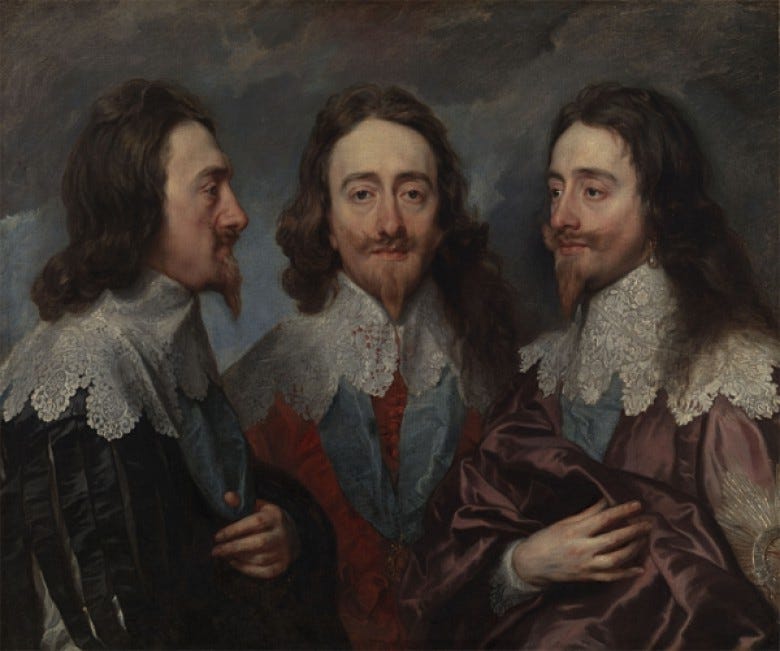
I began writing these words at the Red Lion Inn, at Hillingdon, near Uxbridge, where King Charles I sought refuge after the fall of Oxford to the Puritans in April of 1646. In fact, the room they put me in was the King’s own bedroom; for a man as interested in history as I am, this was an incredible joy. I have begun, with four friends, a journey through the British Isles. Last year we did a similar journey, taking a First-Class Sleeper Train, the Riviera, from London to Penzance. From there we took a ferry to St. Mary’s in the Isles of Scilly.
These bits of land west of Cornwall are said to be the last remains of the lost land of Lyonnesse, renowned in Arthurian legend. Indeed, that whole journey was given over to pursuing the stories of King Arthur. We began by exploring the Duchy of Cornwall, which disputes with the Isle of Man the quality of smallest Celtic land. With Wales and Brittany (where many Britons fled in the 500s) it is one of three refuges into which the invading Anglo-Saxons pushed the descendants of the men who fought for the real-world inspiration of King Arthur. Through the Duchy we travelled, visiting such sights as St. Michael’s Mount; Tintagel Castle (where King Arthur was born) and King Arthur’s Halls in Tintagel; Lanherne Convent; Glastonbury – a true centre of Arthuriana; and Winchester, with its recreated Round Table
This year, we have started in Uxbridge, where is located this ancient inn. But our road shall take us through various Cavalier and Jacobite sites in the Midlands, Wales, Ireland, and Scotland. Different as they are, the nations if the British Isles shared a Faith until the Protestant revolt. From Mary Queen of Scots until the death in 1807 of Cardinal York, de jure King Henry IX of England, Scotland, and Ireland, the House of Stuart (with the partial exception of James I and VI) played the role of defenders of Catholicism and the traditions of their various peoples against Puritanism and latterly the Enlightenment. In a real sense they were the protectors and preservers of shrines and holy wells, of King Arthur and Robin Hood, of Christmas and the Maypole, against all who would debase or abolish them.

