

In the Diocese of Lansing, Michigan, St. John the Evangelist parish in Jackson recently unveiled a new series of murals for its sanctuary apse. Painted by liturgical artist Joseph Macklin, the piece took an entire year to complete and depicts themes from the Book of Revelation, especially the Wedding Feast of the Lamb. The art was inspired by late Gothic and early Renaissance styles reminiscent of Botticelli. Rising 32 feet high and spanning 21 feet across, Macklin’s mural returns liturgical beauty to a space that had been—since the 1970s—a boring, blank, beige wall.
The art was unveiled with great fanfare on Christmas Eve, where the vigil Mass was celebrated by Lansing’s ordinary, Bishop Earl Boyea. The story gained national attention and was picked up by the National Catholic Register, who ran a lengthy piece in praise of the art. The NCR piece offers a glimpse into the motivation of St. John’s pastor, Fr. Chas Canoy, in undertaking this immense work:
St. John’s is the oldest church in the Diocese of Lansing. Completed in 1857 and built in Gothic style, it underwent changes in the late 20th century, but thankfully nothing drastic. Both the muralist and priest wanted to “restore its former glory,” Father Canoy told the Register. “We were thinking, ‘What’s the best way to draw people back into sacred art and back into the real significance of what happens at Mass?’”
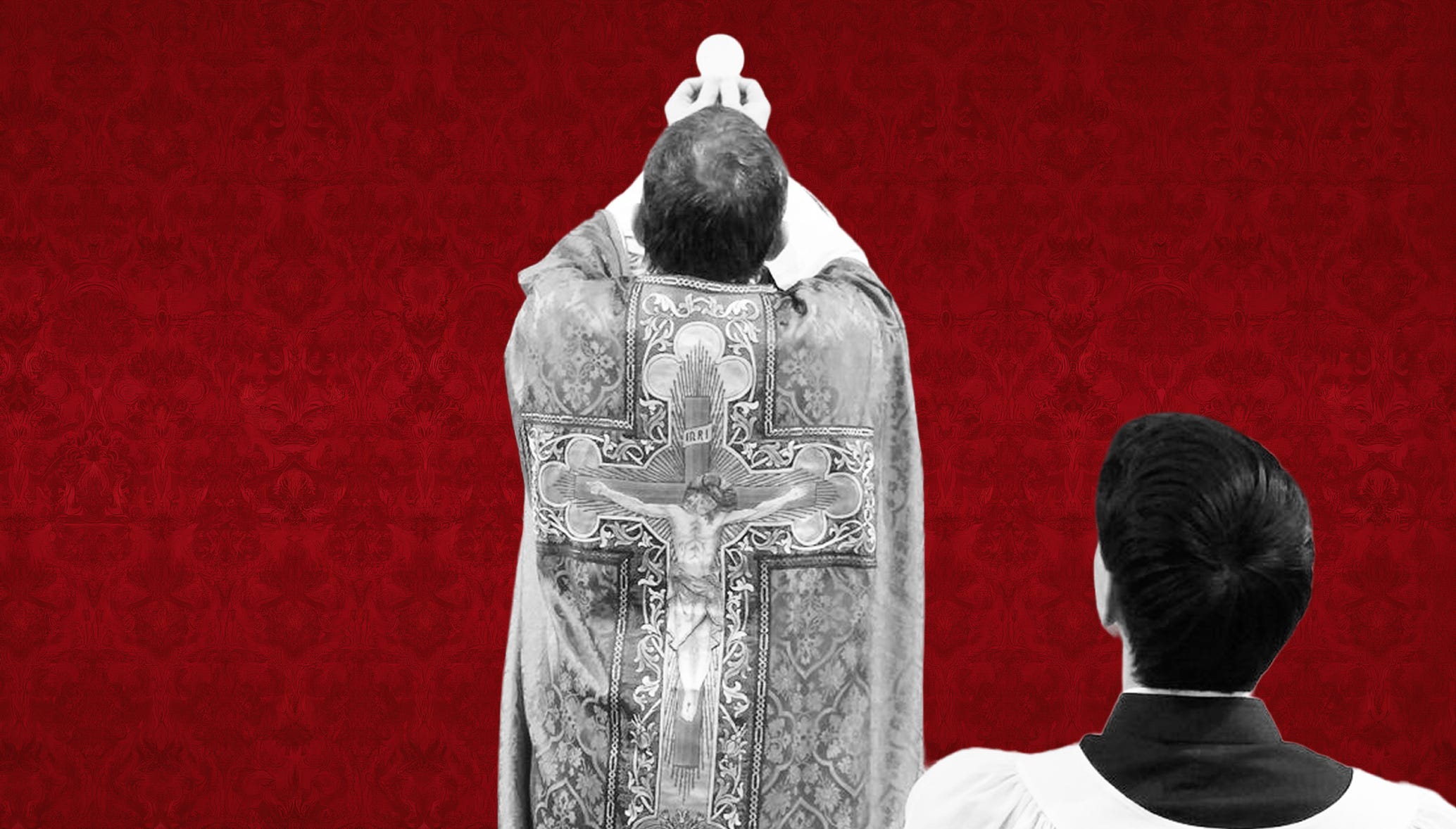
If you click on the NCR link, you can see a picture of the mural with Fr. Canoy in the foreground offering the Eucharist ad orientem.
The story of St. John’s is far from unique. Since the time of Pope Benedict XVI there has been a slow but consistent movement of artistic recovery gaining steam in the American Church. Our Lady of Lourdes in Denver and St. Jude in Spotsylvania are two other recent examples. Readers interested in seeing more such stories should follow Liturgical Arts Journal, which chronicles these sorts of restorations in great detail.
Sometimes I think that Traditional Catholics tend to miss out on this kind of news because we can get preoccupied by the Church’s problems. It’s understandable. The story of the liturgical reform is a tragic story of unprecedented destruction. But we can dwell so much on the catastrophic that it becomes easy to overlook signs of life.
There is more to consider than just art. The theological orientation of priests increasingly trends traditional with every passing year. A 2025 report published by the National Study of Catholic Priests of the Catholic University of America revealed that a whopping 84% of priests ordained since 2020 self-identify as conservative in their theological positions. This number has been steadily rising for years since 1965, when only 16% identified as conservative. According to this study, the high-water mark for the clerical liberal was the 1965-1969 cohort; ordinands since then have slowly but steadily grown more conservative. What is most notable is the rate of change. While previous decades showed slow, incremental shifts of only a few percentage points per year, the amount of clergy identifying as conservative ballooned by 16% between 2015 and 2020, growing from 68% to 84%. Self-identified liberal priests, meanwhile, shrank from 8% to a meager 2% during the same period.[1] We may quibble about what exactly constitutes a “conservative” priest and how this designation was determined, but we cannot deny that overall the theological orientation of priests is trending in the right direction.

Continue Reading or Listening on Pelican Plus
Meanwhile, homeschools and classical academies continue to proliferate throughout the Catholic world, especially in the United States but with smaller but similar movements gaining steam in other countries as well. We do not have data on Catholic homeschooling in particular, but we know that homeschooling in general exploded during the pandemic, with homeschooled children comprising 11% of all students in the U.S. Though these numbers dropped somewhat after Covid they did not return to pre-pandemic levels and remain elevated today. One market study recently predicted that globally, homeschooling could grow at a rate of 10.3% per year for the foreseeable future. If we extrapolate these trends into the Catholic world, where homeschooling has historically been strong, it means that more Catholics today are homeschooling than ever before. Catholics homeschool for a variety of reasons, but being liberal isn’t one of them.
And—while I know this is purely anecdotal—whenever I do attend a Novus Ordo Mass, the quality is clearly better today than it was two decades ago. The full-blown clown liturgies are far less common now than at the turn of the millennium. Yes, NO liturgies are often still sappy, saccharine, and Boomer-core, but the sharp edges are clearly being rounded off as time progresses. I absolutely realize that the situation varies tremendously across dioceses, so take this with a grain of salt, but it is something I have noticed as someone who travels around the country a lot.
Finally, let us not forget the ascendancy of Traditionalist media, which has utterly dominated the Catholic online world in recent years. Some of the biggest Catholic content creators today are Trad or Trad-adjacent. Taylor Marshall has 1.83 million subscribers—more than Fr. Mike Schmitz’s program on Ascension Presents. Matt Fradd, the biggest Catholic podcaster, is Trad-adjacent and has offered a massive platform to numerous Trad personalities. The most visible Catholic television personality, Raymond Arroyo, is a devoted Latin Mass attendee. And perhaps the most influential Catholic publisher—TAN Books—has gone unabashedly Trad, publishing apologias for the Latin Mass by Peter Kwasniewski and all manner of Traditional Catholic material. Can anyone imagine 20 years ago all of the major Catholic media outlets dominated by Traditionalist Catholics? Yet such is the reality in 2026. This is even more important when we consider that these outlets are widely patronized by Novus Ordo Catholics as well, not only in the United States but all over the world. In other words, to the degree that any Catholic, anywhere, consumes any Catholic content at all, he is likely getting it from Trad-aligned sources, whether he realizes it or not.
Over the years I have become convinced that Traditional Catholics can be prone to ignore this kind of stuff because many of us have come to equate the good of the Church with the status of the Traditional Latin Mass exclusively. We can get indignant at the suggestion that anything good is happening so long as the TLM remains shackled and persecuted. We tend to imagine very little overlap between Novus Ordo Catholicism and Traditional Catholicism, as if these are two entirely different segments of the Church with nothing between them. The fact is, these boundaries are far more permeable than many imagine. Most Catholics’ exposure to the Traditional Latin Mass comes from diocesan Latin Masses held at locations that also celebrate the Novus Ordo (before Traditiones custodes this was over 90%. It is less now as restrictions have funneled more Catholics towards Ecclesia Dei communities and the SSPX, but I’m fairly certain it is still a majority). Of these Catholics attending diocesan TLMs, most do not do so exclusively, their liturgical life tending to be a blend between the Ordinary and Extraordinary Forms.
What goes on in the Novus Ordo world is not irrelevant to Trads, nor should it be. Whatever we think of it, the Novus Ordo is the experience of the majority of Latin rite Catholics; even most attendees of the TLM still go to the NO at least semi-regularly. I think this is, to some degree, what is responsible for a lot of the positive changes I highlighted above. What we could call the inter-permeability of Novus Ordo and TLM communities has gradually shifted the Overton Window within the Church further towards Tradition, to the point now that things unthinkable two decades ago are becoming normative. The intellectual momentum is with Traditionalists, who have consistently been pulling the rest of the Church with them for a while now. Reverence in the Novus Ordo is a “gateway drug,” so to speak, for the Traditional Latin Mass. Many Trads begin their discovery of the TLM through experiencing elements of Tradition in the Novus Ordo. Liberal bishops know this; that’s exactly why they not only attack the Latin Mass but also proscribe expressions of Tradition in the Novus Ordo. They understand that too much exposure to Tradition leads one inexorably towards the Mass of Ages and are trying desperately to halt the Tradward slide of their parishes. I personally believe this will ultimately prove too little too late. The Trad horse is out of the stables and it’s too far gone to be put back in.
Some may scoff; some may suggest that there has been no progress whatsoever. I strongly contest this, especially if the criticism is coming from someone who has no substantial involvement with the Novus Ordo world. But for those of us who do, there has been clear and demonstrable improvement.
Am I suggesting we abandon our devotion to the TLM and invest energy in trying to “fix” the Novus Ordo? Absolutely not. Much less am I suggesting reform of the reform is the answer. Even the Novus Ordo with the most optimal optionality would still be inferior to the Traditional Latin Mass. The future of the Church is with the TLM. What I am saying, however, is that even in the Novus Ordo world there are signs of movement in the right direction. Think of it like this—it is not uncommon for people to undergo a “health conversion,” where a sedentary, overweight person will realize they need a radical change and transform themselves through better nutrition, regular exercise, and living habits. Few people ever make the full transition from sedentary to fit in one leap; they start with a little here and a little there. Maybe they begin by reducing their alcohol consumption, or going for little walks. Later they may start running and counting calories. Eventually they may even find themselves in the gym and wind up with a six pack. Any one of these little steps along the way is progress in the right direction. No person who has gotten healthy, however fit he may be, despises the fat man he sees on the treadmill, for that fellow is actively moving in the right direction, and that is laudable, even if he still has a long way to go.
Similarly, it is right to acknowledge progress in the Novus Ordo world when it appears—and it is appearing more frequently. I do not want to overstate the case, of course; there are still vast liturgical wastelands where it is difficult to find any reverence outside of traditional communities. And the episcopate and papacy remain wildcards, largely developing along different trajectories than those forming the Catholic laity. On my blog I recently suggested the laity may yet have an important part to play in the restoration of the Church; only time will tell. Sometimes it seems that we feel like there can’t be anything good happening in the Novus Ordo world on principle—as if it simply has to be all bad news all the time. The Church’s problems are real and they are serious; nothing written here should be taken as minimizing them. But a movement confident in its own future ought to be able to hold two things at once: a clear-eyed account of what remains broken, and genuine recognition of what is being rebuilt. Both are acts of honesty, admirably suited to a truly Catholic vision.
[1] See the National Study of Catholic Priests’ report online at https://catholicproject.catholic.edu/national-study-of-catholic-priests/
Connect with the author on Pelican+ Social

Get the Full Experience on the Pelican+ App

I am thrilled to see that the author of our favorite history CDs (not to mention the incredible “Story of Mary” CDs) is a TLM guy! I wholeheartedly agree with your essay. Keep pumping out history CDs, and consider adding stories of the saints, too! We live in the country and drives to town or to mass take anywhere from 30 min to 1 hr 15 min, and having CDs to listen to makes the drive positively pleasant. My very young children retain well your excellent narratives.
I was a seminarian in Lansing, so I don’t take these issues lightly. The difficulty for me has been that even granting everything you’ve said about the errors, it still doesn’t seem to resolve who concretely has the mission to act in the Church’s name.