

As the sixty-first anniversary of the closing of the Second Vatican Council approaches (December 8, 2026), the nature of its endlessly vaunted but never sufficiently explained “legacy” could not be more apparent. It is not the conciliar texts totidem verbis in which we find this legacy but rather in the practical outcome of their overall rhetorical tendency, that being an abrupt abandonment of the Church’s perennial opposition to the spirit of the age in favor of what Pius XII presciently condemned as a “false irenism” in his landmark encyclical Humani Generis. By this Pius meant that neo-Modernist attitude which views “as an obstacle to the restoration of fraternal union, things founded on the laws and principles given by Christ and likewise on institutions founded by Him, or which are the defense and support of the integrity of the faith, and the removal of which would bring about the union of all, but only to their destruction.” In other words, the traditional teaching, practice and constitution of the Catholic Church are deemed “obstacles” to universal brotherhood rather than the only way to achieve it in the brotherhood that is Catholic Christendom. False irenism is, in fact, the very program of political modernity in its ceaseless opposition to Catholic social order.
Pius would later confide to Cardinal Ernesto Ruffini that he had promulgated Humani Generis and taken action to implement it because “everything was being lost.” What Pius foresaw was nothing less than the looming threat that the human element of the Church would simply surrender to the zeitgeist in practically every department so as to become de facto, as Louis Veuillot so vividly put it nearly a century earlier, “sufficiently nothing to live in peace with the rest of the world.” We cannot forget that nineteen years before he promulgated Humani Generis, the future Pius XII, speaking as Eugenio Pacelli, Secretary of State under Pius XI, uttered this prophecy in light of the Message of Fatima:
Supposing, dear friend, that communism is not the most visible of the organs of subversion against the Church and against tradition and divine revelation, then we all assist in the invasion of all that is spiritual, philosophy, science, law, teaching, the arts, the press, literature, theater and religion.
I am worried by the Blessed Virgin’s messages to Lucy of Fatima. This persistence of Mary about the dangers which menace the Church is a divine warning against the suicide that would be represented by the alteration of the faith, in her liturgy, her theology and her soul.
I hear all around me innovators who wish to dismantle the Sacred Chapel, destroy the universal flame of the Church, reject her ornaments and make her feel remorse for her historical past. Well, my dear friend, I am convinced that the Church of Peter must accept its past or else dig its own grave….
A day will come when the civilized world will deny its God, when the Church will doubt as Peter doubted. She will be tempted to believe that man has become God. In our churches, Christians will search in vain for the red lamp where God awaits them. Like Mary Magdalene, weeping before the empty tomb, they will ask, “Where have they taken Him?”
The Irenism of Vatican II
Only 34 years later, wittingly or not, Paul VI would enunciate a version of “false irenism” as the very motif of the Council over which he had presided. Speaking on the day before its official conclusion, Paul made an admission about the Council that would have stupefied every Pope before him, including the one who had so impetuously convoked it:
But one must realize that this council, which exposed itself to human judgment, insisted very much more upon this pleasant side of man, rather than on his unpleasant one. Its attitude was very much and deliberately optimistic. A wave of affection and admiration flowed from the council over the modern world of humanity…. Instead of depressing diagnoses, encouraging remedies; instead of direful prognostics, messages of trust issued from the council to the present-day world. The modern world’s values were not only respected but honored, its efforts approved, its aspirations purified and blessed.
The Council that “exposed itself to human judgment” would lead to a Church whose leaders allowed themselves to be daunted by the world’s view of her. The Church that is “the sole depository and interpreter of the ideals and teachings of Christ” and which “alone can introduce into society and maintain therein the prestige of a true, sound spiritualism, the spiritualism of Christianity,” as Pius XI insisted, would give way in its human element to the Council’s novelties of “dialogue” and “ecumenism.” The new ecclesial orientation introduced by the Council’s unprecedented irenicism toward a hostile world was aptly summarized by the great Romano Amerio decades before the post-conciliar crisis reached its zenith with the arrival of Jorge Mario Bergoglio on the Chair of Peter: “the demands and claims of the world, which were then external to the Church and opposed by her, have now been internalized within her, and the antagonism between the Church and the world abandoned….”
Where the papacy is concerned, the role of the Pope as teacher to the world rapidly waned after the Council—first in the realm of religious truth as the result of ecumenism and dialogue, the mainsprings of the Church’s sudden and substantial adequation to the spirit of the age. This was seen during the pontificates of Paul VI, John Paul II and, albeit much more moderately, even that of Benedict XVI, who at least attempted an ecclesial restoration of sorts. But with the advent of Bergoglio and the infamous Amoris laetitia, the Church’s de facto surrender to “the demands and claims of the world” would be extended even to the natural law on marriage and procreation—in direct contradiction to the traditional moral teaching of those three Popes. Bergoglio’s parting blow to the Church’s moral edifice came in the form of Fiducia supplicans, authorizing “simple,” “spontaneous,” “short,” and “non-liturgical” blessings to couples cohabitating in adultery, the divorced-and-“remarried”, and even “same-sex couples.”
Concerning Bergoglio’s disgraceful capitulation to the moral depravity of our age, the aptly named Bishop Athanasius Schneider protested that “Fiducia Supplicans seriously undermines the Catholic faith and morals, turning the Catholic Church, at least in practice, into a welcoming and nurturing environment for unrepentant homosexuals and adulterers who lead sinful lifestyles, instead of calling such sinners to repentance….” Bergoglio’s papacy also exhibited a political agenda virtually indistinguishable from that of the officially atheistic European Union, including “climate change,” open borders, anti-populism, mandatory COVID vaccination, and even civil recognition of “same-sex unions.” And while Bergoglio maintained a pro forma opposition to abortion, he never demanded its universal abolition, as he did incessantly respecting capital punishment. (Leo XIV, following suit, now declares simply that “I condemn capital punishment,” thus necessarily implying, to the world’s delight, that the Church had taught error on the subject for 2,000 years and that God Himself was mistaken when He revealed the principle of natural justice that “whosever sheds man’s blood, by man his blood shall be shed.”)
Yet throughout the relentless moral disarmament of the papacy since the Council, papal authority would continue to be exercised with brute force for the suppression of conservative forces within the Church, particularly the Society of Saint Pius X. Despite the lifting of the excommunication of its bishops by Pope Benedict, the Society is still deemed to lack “full communion” with the Church. Indeed it does, if we are speaking of the new ecclesial orientation adopted in the name of Vatican II as opposed to the unreconstructed Catholic religion as it existed before the Council, and the Popes who fought against the conquering march of the zeitgeist at the very gates of Eternal Rome.
The Conciliar Vicar of the Zeitgeist
Given the evidence of our senses, it is no exaggeration to say that by the time Robert Francis Prevost was elected to the papacy, the Vicar of Christ had allowed himself to become effectively a Vicar of the Zeitgeist. Nowhere is this more apparent than Leo XIV’s response to a reporter’s question about what he intended to do concerning Cardinal Reinhard Marx’s determination to extend Fiducia supplicans—as it inevitably would be—to the formal blessing of “same-sex couples.” To quote Leo’s remarks in full is to demonstrate the astonishing extent to which the conciliar aggiornamento has produced, as Paul VI lamented too late, a “veritable invasion of the Church by worldly thinking.” Quoth Leo:
First of all, I think it’s very important to understand that the unity or division of the Church should not revolve around sexual matters. We tend to think that when the Church is talking about morality, that the only issue of morality is sexual. And in reality, I believe there are much greater, more important issues, such as justice, equality, freedom of men and women, freedom of religion, that would all take priority before that particular issue. The Holy See has already spoken to the German bishops.
The Holy See has made it clear that we do not agree with the formalized blessing of couples, in this case, homosexual couples, as you asked, or couples in irregular situations, beyond what was specifically, if you will, allowed for by Pope Francis in saying all people receive blessings.
When a priest gives a blessing at the end of Mass, when the Pope gives a blessing at the end of a large celebration like the one we had today, they are blessings for all people. Francis’ well-known expression ‘Tutti, tutti, tutti’ is an expression of the Church’s belief that all are welcome; all are invited; all are invited to follow Jesus, and all are invited to look for conversion in their lives.
To go beyond that today, I think that the topic can cause more disunity than unity, and that we should look for ways to build our unity upon Jesus Christ and what Jesus Christ teaches. So that’s how I would respond to that question.
Note, first of all, the insulting resort to the sophistry of a slick politician: blessing a crowd at Mass is just the same as blessing a pair of homosexuals who purport to be married. Notice also Leo’s mere “disagreement” with Marx’s “formal blessings” for “homosexual couples.” No discipline for Marx, who is undermining the entire moral order in Germany, but looming excommunication for the Society of Saint Pius X. But then Marx is in “full communion” with Leo, their “disagreement” over mere sexual morality aside.
Not for a Vicar of the Zeitgeist is the admonition of Our Lady of Fatima that “The sins which cause most souls to go to hell are the sins of the flesh” or that of Padre Pio that the sin of impurity “destroys the soul’s light with frightening speed” and hardens it against the sacrament of Confession out of a prideful fear of humiliation. Not for a Vicar of the Zeitgeist is any recognition of the “silent apostasy,” as John Paul II called it, that has resulted principally from violations of the Sixth Commandment in the form of fornication, pornography, divorce, contraception, abortion and homosexuality, which have caused irreparable harm to the social nucleus of the family, the loss of grace and a darkening of the will throughout our entire post-Christian civilization. For a Vicar of the Zeitgeist, focus on the sexual sins ruining both souls and society “can cause more disunity than unity” whereas “justice, equality, freedom of men and women, freedom of religion”—the revolutionary shibboleths on which post-Christian modernity was founded—are much more important matters.
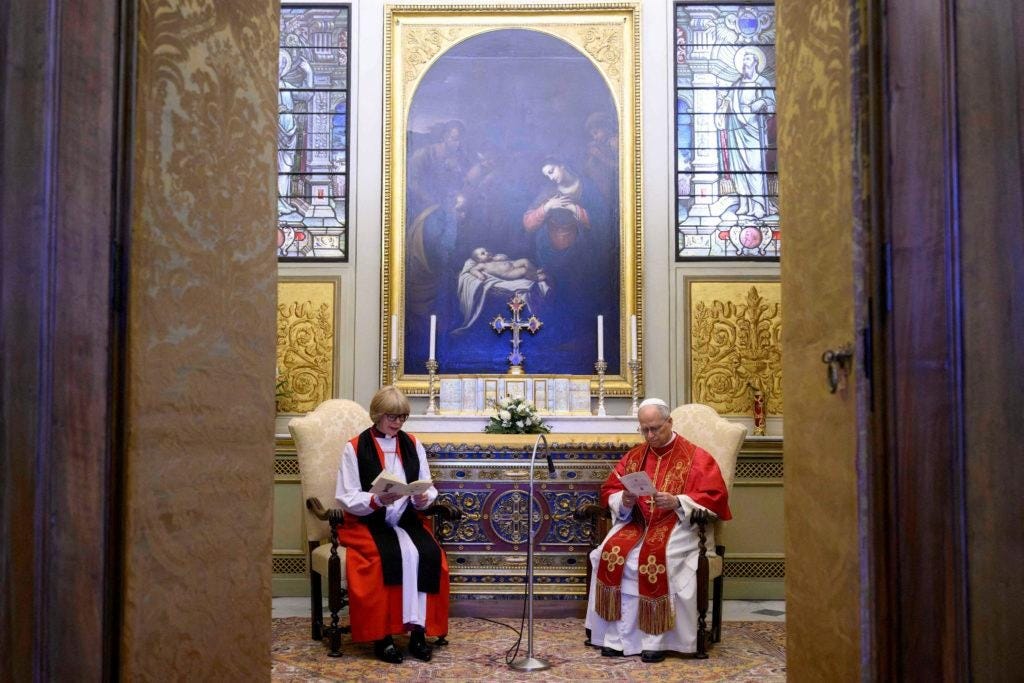
So declared the Pope who began his papacy by imparting a papal blessing to a block of ice in order to manifest his assent to the quasi-religious “climate change” ideology. So declared the Pope who received in audience and prayed together with a ridiculous woman in a clerical costume who claims to be the Archbishop of Canterbury, calling her “Dear sister” and “Your Grace”, and daring to utter the nothing-less-than blasphemous prayer “that the same Holy Spirit will remain with you always, making you fruitful in the service to which you have been called.”
Only a Vicar of the Zeitgeist would thus dignify an ecclesiastical fraud whose “ordination” has been rejected as “grievous” even by conservative Anglicans, and who declared only days ago that “there can be limited conditions under which abortion may be preferable to any available alternatives.” Only a Vicar of the Zeitgeist would allow himself to be seen as being on equal footing with a heretic who is neither a priest nor a bishop and whose “church” not only condones women’s ordination, contraception and divorce but was blessing “same-sex couples” years before Bergoglio, the first fully realized Vicar of the Zeitgeist, decided to adopt the Anglicans’ depraved practice.
The Conciliar “Legacy”
On the first anniversary of Bergoglio’s death, Pope Leo issued a message to Cardinal Re, Dean of the College of Cardinals, in which he stated that his predecessor “took up the legacy of the Second Vatican Council and urged the Church to be open to mission, a guardian of the world’s hope, passionate about proclaiming that Gospel which is capable of giving every life fulfilment and happiness.”
Behold the “legacy of the Second Vatican Council”: gauzy rhetoric about hope and references to “mission” bereft of even the faintest suggestion that conversion to the Catholic faith is a matter of life and death for souls.
Behold “the legacy of the Second Council”: a neutered papacy that would never dare to offend the world by reminding it of Christ’s warning that “whosoever shall look on a woman to lust after her, hath already committed adultery with her in his heart”, but on the contrary a papacy that opens the door to Holy Communion for public adulterers in defiance of Our Lord’s injunction that “Whosoever shall put away his wife and marry another, committeth adultery against her.”
Behold “the legacy of the Second Vatican Council”: “informal” blessings for “same-sex couples” rather than proclamation of the revealed truth, respecting heathens of every epoch, that “God delivered them up to shameful affections, so that “women have changed the natural use into that use which is against nature” and “the men also… men with men working that which is filthy, and receiving in themselves the recompense which was due to their error.”
Behold the “legacy of the Second Vatican Council”: a Pope who considers defense of the Sixth Commandment divisive, views equality and freedom of religion as “much greater, more important issues,” and accords full ecclesiastical dignity and honors to the absurd female leader of an absurd pseudo-church that condones the murder of innocents in the womb and teaches all manner of other damnable error.
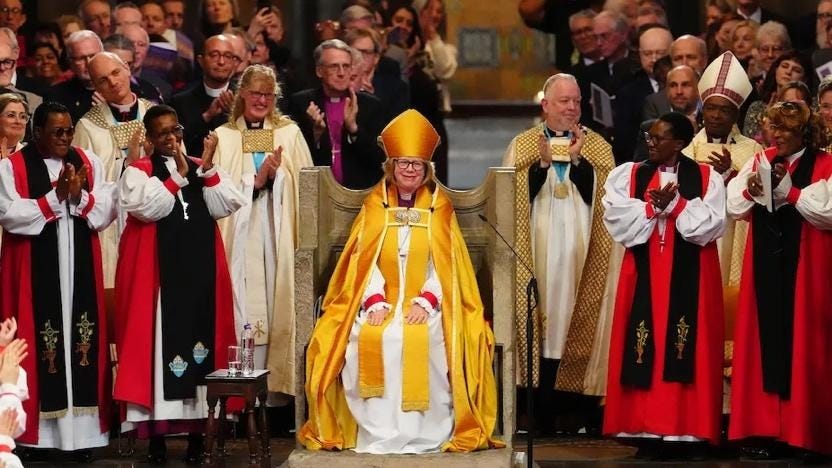
Behold “the legacy of the Second Vatican Council”: rejection of the Church’s constant teaching against the very thing Pius XI condemned but which the post-conciliar Church now embraces with voluptuous abandon: “intercourse with those who professed a mutilated and corrupt version of Christ’s teaching…”
Behold “the legacy of the Second Vatican Council”: passive acceptance and even “blessings” for adultery and sexual deviancy, papal inaction in the face of rampant heresy and orthopraxis, but a ludicrous “re-excommunication” for the bishops of SSPX, who are denounced as “lacking full communion.”
The “legacy of the Second Vatican Council” is, in short, the salt that has lost its savor and “is good for nothing any more but to be cast out, and to be trodden on by men.” And just as it was at the height of the Arian heresy, so it is today: “Only one offense is now vigorously punished,” lamented St. Basil the Great, “an accurate observance of our fathers’ traditions. For this cause the pious are driven from their countries and transported into deserts.” Only today the “desert” consists of that ecclesiastical ghetto denominated “lack of full communion.” Full communion, that is, with the “legacy of the Second Vatican Council.” For the whole of Catholic teaching and praxis must be subordinated to what happened at the “zero hour” of a Council whose unprecedented bid for human respect has led its hopelessly blinkered partisans to reject St. Paul’s counsel to “Preach the word: be instant in season, out of season: reprove, entreat, rebuke in all patience and doctrine.”
The “legacy of the Second Vatican Council” seems alarmingly well-suited to Paul’s prophesy of that time, near the end of time, “when they will not endure sound doctrine; but, according to their own desires, they will heap to themselves teachers, having itching ears: And will indeed turn away their hearing from the truth, but will be turned unto fables.” And the greatest of these fables is the preaching, not of the revealed truth that Christ likened to a sword that divides, but what Pius XII condemned as “the union of all, but only to their destruction.”