

Controversy broke out yesterday after Pelican+ Co-Founder Dr. Kwasniewski reported that Cardinal Roche “ordered that priests must cease to function as deacons or subdeacons (and deacons as subdeacons) during solemn Mass but rather, if there is more than one priest, they must all concelebrate, and deacons may only function as deacons.”
This practice should be familiar to those who frequent the Traditional Latin Mass, as the height of the Roman Rite, is most gloriously seen in the Solemn High Mass, where there are roles for a priest, a deacon and a subdeacon. Outside of a seminary environment, the average Catholic will see a Solemn High Mass most frequently done with three priests, one acting as celebrant and the other two “dressing down” to act as deacon and subdeacon, as the ordained priest remains a deacon and a subdeacon despite having a higher order. There are very few parishes if any parishes where there are men ordained merely subdeacons who actively partake in the liturgy.
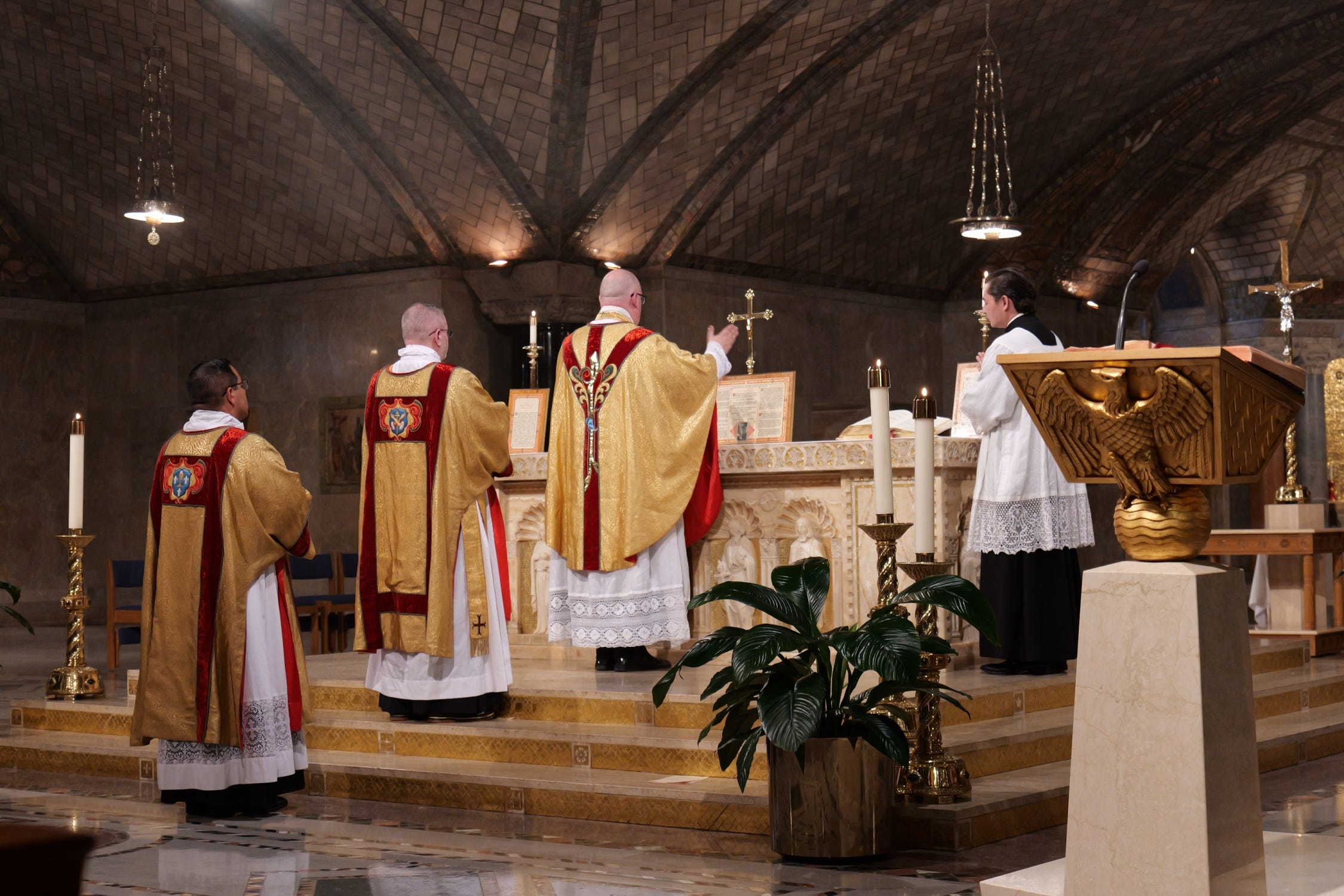
This practice, however, has gone out of favor with the post-conciliar hierarchy since the liturgical changes of the 1960s, with priests concelebrating being preferred instead.
There were conflicting reports about when and with whom this meeting actually took place. Soon after the report of Dr. Kwasniewski there was a report from The Pillar having spoken to Bishop David Waller, the head of the U.K.’s personal Ordinariate. In that communication, His Excellency denied any such meeting with Cardinal Roche but despite widespread internet comments suggesting the contrary, the Bishop affirmed that the change in policy that Dr. Kwasniewski had reported was indeed now in force. The Bishop stated:
“[A]ny priest has the right to celebrate individually. That’s law, not just for the ordinariate. What is not permissible is priests dressing as deacons and subdeacons,”
This statement raises questions and concerns for a few reasons. Firstly, it seemingly contradicts what is actually on the books for the Ordinariate’s Liturgy. Matthew Hazell pointed out that the Divine Worship’s Rubrical Directory states that:
“In the absence of a second Deacon, another cleric or even an Instituted Acolyte may serve the subdiaconal ministry and read the epistle.”
Another problem exists within the Bishop’s statement in that every priest receives and permanently retains the lower diaconal orders virtually through his ordination. Therefore a priest would not be dressing up as a deacon as one usurping a role he does not possess, but would be just as much of a deacon as any other permanent deacon.
The application of the rule is also puzzling from the perspective of the charism of the Anglican patrimony. Concelebration is foreign to the 1662 Book of Common Prayer and to Anglican practice generally until the Church of England borrowed the practice from post-Vatican II Roman usage in 1971.
Dr. Kwasniewski later clarified that his source “specified that it was a meeting of Bishop Steven Lopes with Cardinal Roche.” Bishop Lopes is the current head of the American Personal Ordinariate of the Chair of St. Peter. Regardless of the meeting, this does represent a shift in liturgical paradigm for the Anglican patrimony within the Catholic Church and is another moment in the struggle for the Ordinariates to find their identity. If the liturgical inheritance of the Ordinariates lies not in the Sarum Use of English antiquity, nor in the liturgics of the English Reformation but instead is based on the same constant aggiornamento present in the New Rite of the 1960s, can there be said to exist an Anglican patrimony within the Catholic Church at all?
Connect with the author on Pelican+ Social

Bp. Lopes’ name immediately rang a bell. One of his first acts as Bp. of the Ordinariate was to laicize a Texas priest for criticizing Vatican II during a sermon.
This doesn't make any sense to me.