Of the 10 million Catholics living in China, six million belong to their government’s version of Catholicism, the Chinese Catholic Patriotic Association (CCPA). The rest live off the grid, without access to the sacraments and often without the fellowship of fellow Catholics.
Any Catholic found worshiping outside the confines of the CCPA is subject to legal sanctions of fines and/or imprisonment. Any priests or bishops serving their fellow exiles are subject to immediate detainment, imprisonment, torture, and even death.
While statistics coming out of China should be taken with a shaker of salt, there are said to be 343 Catholic churches in 147 dioceses, served by 93 bishops and perhaps 4,000 priests.[1] That there are Catholics at all in China is credit to the Franciscan and Jesuit orders, who evangelized Asia centuries ago.
A Franciscan
An Italian Franciscan named Giovanni da Montecorvino (John) entered the Imperial City of Beijing in 1294. He came as a papal legate of Pope Nicholas to establish relations with the Khan of the reigning Yuan (Mongol) dynasty, who had passed word of his receptivity to Christianity to the pope.
But it took years to travel between countries back then, and Kublai Khan died before John arrived. John also missed meeting a friend of Kublai Khan named Marco Polo. John’s fellow Italian left Beijing for Venice the same year John arrived in Beijing.
But John’s story is more than ships passing in the night. He became friends with China’s new ruler, Timur Khan, who allowed John to be a missionary. Timur was far less opposed to John than the Christian Nestorians in the area.[2]
John learned the Uyghur language used by the Mongol ruling class of the Yuan dynasty, and preached to audiences in their native tongue. He also translated the New Testament and the Psalms into Uyghur. In 1299 the first Catholic church was built in Peking. By 1305 a second church was built, and John had won over 1,000 converts.[3]
Abodes and workshops were built for more than one hundred local boys. From John they learned Latin and Greek. He wrote songs and hymns for them, taught them to sing as a choir, and to serve Mass.
In 1307 Pope Clement V commissioned friars to assist John in his labors and to consecrate him as Archbishop of Cambaluc (i.e., Peking), and Primate of the Far East. It is said John helped 6,000 Chinese convert to Christianity, including a Nestorian prince of the Yuan court. In 1328 Giovanni da Montecorvino “departed this life honored as a saint by Christian and heathen.”[4] Today he is venerated as a servant of God.
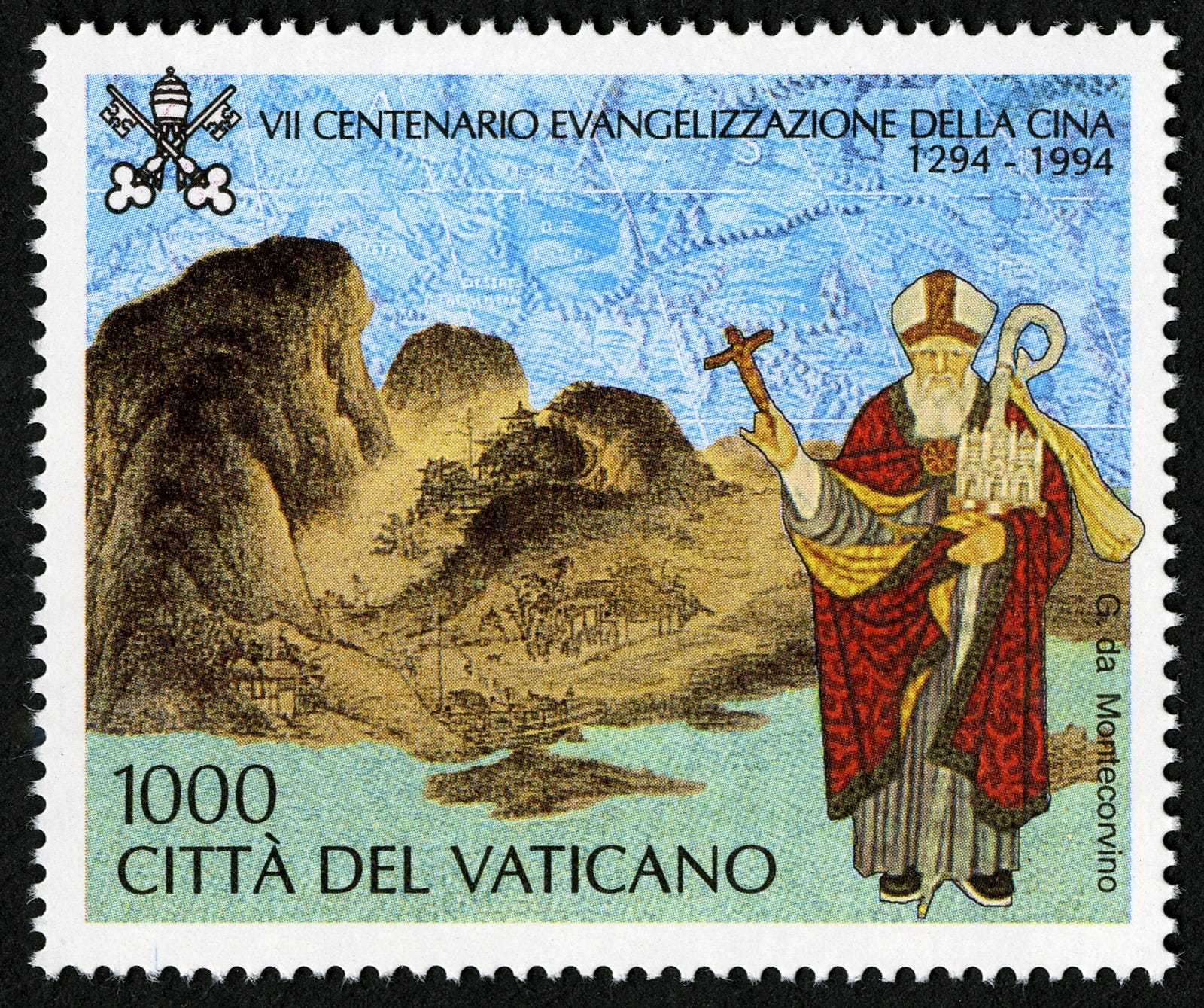
A Jesuit
Chinese rulers initially viewed Christianity as a novelty, a harmless pastime that disciplined young boys and kept them out of trouble. Subsequent rulers were less tolerant. They viewed Christianity as a foreign element, and inferior to Confucianism. Persecutions began.
By the 1500s Chinese rulers had come to believe they possessed exclusive wisdom in all matters. Consequently, there was nothing of value to learn outside of China, including matters of religion. It took a Jesuit named Matteo Ricci to change their minds.
As part of the Counter-Reformation, the Jesuits were sending missionaries around the world to bring Christianity, specifically Catholicism, to pagan lands. Ricci was first sent to India in 1578, and then in 1583 he received an assignment to China. It was there that he would make his name.
Ricci immersed himself in Chinese culture, learned how to read and write the language, adopted Chinese dress, and made friends with Chinese intellectuals and scholars.
Only then did Father Ricci approach Chinese authorities. He asked permission to enter Beijing, not to evangelize, but to receive the great wisdom of the Chinese rulers. This transparent flattery was accepted as truth by the all-knowing members of the ruling Ming dynasty. In 1583 Ricci and the Jesuits were allowed to enter the Imperial City of Beijing.

Try out the Pelican+ App today!
Once settled, Ricci and company targeted the royal court, charming their hosts with gracious words and amazing them with European inventions: clocks of all shapes and sizes; mathematical and astronomical instruments; artwork; architectural designs of buildings, houses, and towns; and more.
Ricci used the inventions to generate discussion and dialogue. It was also a polite, indirect response to the presumption among Chinese rulers that all Westerners were ignorant barbarians. He hoped to make the Chinese not only curious about European inventions, but Christianity too.
Ricci’s interactions with Chinese rulers went so well they let him enter the Forbidden City within the Imperial City: the huge imperial palace complex in the heart of Beijing that spans 180 acres and contains 9,999 rooms.[5] It was the home of Chinese emperors for five hundred years, but only a select few were ever allowed in.
Yes, Chinese rulers were full of themselves at times, but they could also claim many national accomplishments over the centuries. Along with the Great Wall, the Forbidden City is certainly one of those triumphs. It is universally hailed as “a true marvel of architecture and history.”[6]
Ricci and companions marveled at the Forbidden City, and other examples of China’s accomplishments. Chinese maps, however, needed help. Their own country was the only nation displayed. The rest of the world outside the Great Wall consisted of a few ponds and islands.
Ming rulers were initially outraged at Ricci’s maps, and the relatively small size of China compared to the rest of the world. Later Ricci said:
“This was the most useful work that could be done at that time to dispose China to give credence to the things of our holy Faith…Their conception of the greatness of their country and of the insignificance of all other lands made them so proud…it was scarcely to be expected that they would heed foreign masters.”[7]
Ricci and his fellow Jesuits earned the respect of the Chinese. In 1601 the Jesuits were given permission to establish a mission in Beijing. This was an honor, as Beijing was traditionally closed to foreigners. It was evidence of the positive exchanges of culture between the two groups, and the facility of Jesuits planting seeds of Christianity wherever they could.
Ricci’s health began failing, and in June 1610 he died at age 58. Foreigners were not allowed to be buried in the Imperial City. They were interred in nearby Macao. The Jesuits requested an exception to this rule for Father Ricci, citing his love of Chinese culture, the genuine friendships he had created between races, and the value Ricci gave Chinese rulers by showing them edifying aspects of Western culture.
By special order of Emperor Wanli, Matteo Ricci was allowed to be buried in the Imperial City. This imperial exception allowed Ricci’s body to be interred in an above ground temple in northern Beijing. In a further sign of his impact on Chinese rulers, the Ming dynasty officially referred to Father Matteo Ricci as the “Wise Man of the Great West.”[8]
The Jesuits’ discreet catechizing of China continued for centuries. In addition to language barriers, centuries of Chinese culture and the prominence of Confucianism made it difficult to secure a spiritual foothold. Still, they persisted. Eventually Dominicans and Augustinians joined in. The Church in China might never be large, but it would never disappear either.
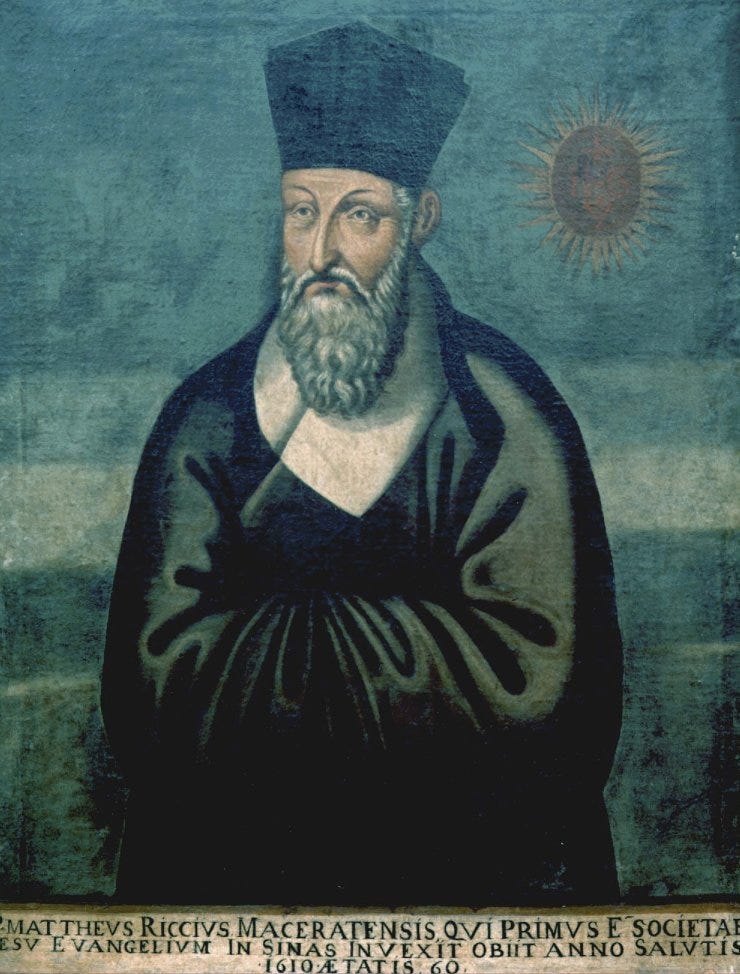
First Martyrs
The first known martyr in China was a Spanish Dominican named Francisco (Francis) Fernandez de Capillas. Francis entered mainland China in 1642 with a small Dominican mission in Fogan (Fu’an) along the coastal region of southern China.
The local population was receptive to the mission, which produced a third (lay) order of Dominicans. But in 1647 the Manchurians swooped into Fogan as part of their conquest of the Ming dynasty. They were hostile to Christianity and began an immediate persecution.
Francis was arrested as he returned to Fogan after delivering sacraments to a sick person. He was insulted, imprisoned, and tortured. Near death, he was moved to the part of prison containing those condemned to die.
A sympathetic jailer gave Francis food and water. He regained enough strength to write some final words:
“I am here with other prisoners and we have developed a fellowship. They ask me about the Gospel of the Lord. I am not concerned about getting out of here because here I know I am doing the will of God. I live here in great joy without any worry, knowing that I am here because of Jesus Christ. The pearls I have found here these days are not always easy to find.”[9]
On 15 January 1648 Francisco Fernandez de Capillas was accused of teaching false doctrines and inciting people against the new rulers. He was decapitated the same day.
Francis was beatified by Pope Pius X on 2 May 1909, along with 14 Chinese laypeople who had also died as martyrs. Their collective memory is remembered on 9 July, while the feast day of Francis Fernández de Capillas is observed on 15 January. He is considered a protomartyr by the Holy See.[10]
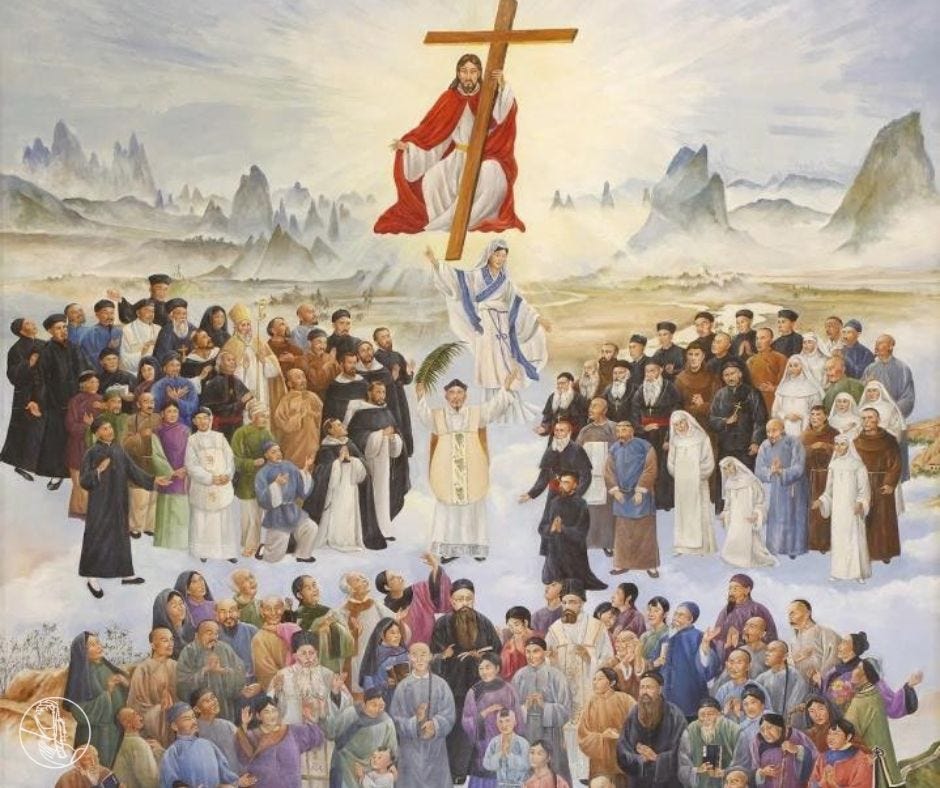
The Boxer Wars
It is difficult to gauge the number of martyrs for the faith in China over the centuries. Hostility towards the faith waxed and waned depending on the dynasty in charge, and ruler change within dynasties. The worst persecution prior to Communism was probably the so called “Boxer Rebellion,” also known as the Boxer Wars.
For reasons unclear Christians and “foreigner” missionaries were scapegoated as being responsible for a prolonged series of droughts, famines, and floods across large portions of China, and the painful aftermath of these disasters.
The persecution originated in a secret society known as the “Boxers”, a Chinese martial arts sect. Membership required advanced fighting skills, a spiritualized conviction that these skills created secret special knowledge, and rabid belief in this knowledge.
The Boxer persecution was severe, in part because large portions of the Qing dynasty joined the violence. Estimates of Chinese Christians killed because of their faith vary from 30,000 to 100,000. Two hundred missionaries were also killed.[11] The violence lasted two years, and would have continued longer had not a well-armed international alliance of 20,000 troops from 8 nations forcibly intervened. The Boxers’ spiritual and fighting prowess proved no match for this force of arms, which rescued their persecuted populations and ended the fighting.
As part of a settlement agreement the empress dowager of the Qing dynasty agreed to pay various nations a total in excess of $350 million (real money amount at the time), and to allow Christians and missionaries to practice their religion without interference.
The Boxer War also signaled the end of dynastic rule in China. The Qing dynasty limped along for another decade, but in 1911 was overthrown in the Xinhai Revolution. An alliance led by Sun Yat-sen replaced centuries of dynastic rule with a new, republican form of government.
Dynasties, it seems, were no less prone to corruption, incompetence, and bloated egos than any other form of government, including republics. China’s republican form of government would not last even forty years before falling in yet another revolution.
Mao
An avid follower of the 1911 Revolution was an eighteen-year-old Peking University student named Mao Zedong.
Born into a poor Chinese peasant family, Mao learned about Marxism while working at the Peking University library. Ten years later he was a founding member of the Chinese Communist Party (CCP). The party’s military arm was the Red Army, which engaged in a lengthy civil war against the fledgling Republic of China.