Saint Francis of Assisi inaugurated his religious vocation with a striking gesture of humility: stripping himself naked in the piazza of Assisi before the episcopal palace, he handed his clothes to his father and said, “From now on I can freely say ‘Our Father who art in heaven,’ not father Peter Bernardone.”[1] This act of renunciation signified Francis’s repudiation of the class identity he was born into and his embrace of a new way of life, wedded to Lady Poverty.
The concepts of humility, renunciation, and exposure are deeply connected in the Franciscan tradition. Renunciation of worldly pomp entails walking away from the things that give us a false sense of control over our lives. This could sometimes include clothing itself. Clothing was an extremely important indicator of class in the medieval world. Medieval Italy in particular was deeply stratified with differing social castes going about in vesture so rigidly distinguished as to constitute a kind of medieval dress code. This was legally enforced by so-called Sumptuary Laws, legal statutes mandating that every person dress according to their station. [2] Divesting oneself thus constituted a radical act of public humiliation.
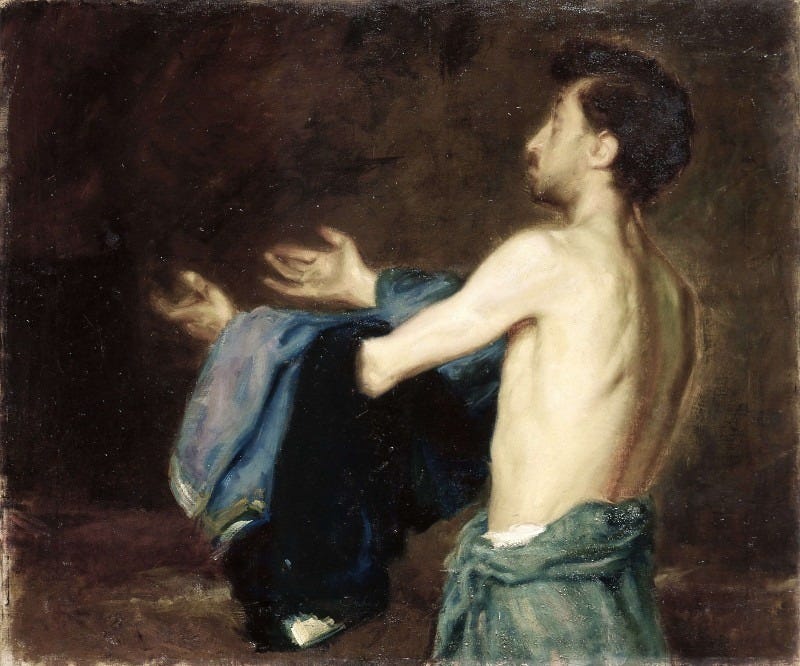
Saint Francis was fond of equating this with Christ’s nakedness on the cross. We are told that one of his favorite topics of preaching was “holy penance, holy voluntary poverty…and about the nakedness and humiliations and most holy Passion of Our Lord Jesus Christ crucified.”[3] When he was dying, too, Saint Bonaventure tells us that Francis “laid aside his habit, and laid himself prostrate on the bare earth, that in the last hour in which the enemy would attack him with all his fury he might wrestle naked with the adversary.”[4] One of his friars, moved by the sight of Francis’s nakedness, brought the tunic of another and covered him, even as Noah’s sons had covered their father’s nakedness (cf. Gen. 9:20-27). Saint Bonaventure connects these events with Christ’s nakedness on the cross as well. He wrote:
And all these things he did out of his zeal for poverty, so that he would not have even a habit but what was lent him by another. For in all things, assuredly, he desired to be conformed to Christ crucified, who hung naked upon the cross, in poverty and pain. And therefore, as at the beginning of his conversion, when he cast off his garment before the bishop, so at the end of his life he desired to depart naked out of this world.[5]
Saint Francis considered the state of nakedness to be a particularly intimate manner of conforming oneself to Christ, specifically in His humiliation. This is why Franciscans have tended to view humility in terms of humiliation: we grow in humility precisely by being perceived as foolish and contemptible in the eyes of the world. Consider the following story from the Little Flowers of Saint Francis concerning the life of the Servant of God, Brother Juniper. The story is worth quoting at length, as it demonstrates the extraordinary efforts a zealous friar might go to in order to humiliate himself through nakedness:
Once, Brother Juniper, wishing to humiliate himself thoroughly, stripped himself completely naked. He put his breeches on his head and tied his habit into a bundle with his cord and put it around his neck. And he went into Viterbo that way and went to the market place to be mocked. While he sat there naked, some children and boys understandably thought he was insane and mistreated him a good deal, mocking and insulting him, throwing mud and stones at him, and pushing him back and forth. After being derided and tormented by them for a long time, he went to the friary, still naked.
Now when the friars saw him, they were profoundly shocked and angry at him, especially because he had gone through the whole town like that, with his bundle on his head. They scolded him very severely and shouted serious threats at him. One of them said: “Let us put him in prison!” Another said: “He should be burned at the stake!” And others: “No penalty could be too great for the shocking example he has given today of himself and of the whole Order!”
And Brother Juniper listened cheerfully and answered humbly and with great joy: “You are right. I deserve all those punishments and still greater ones for giving such scandal.”
To the glory of Christ. Amen.[6]
We may certainly quibble with the prudence behind Juniper’s decision—the early Franciscans had a penchant for public displays considered outlandish even by many of their contemporaries. This arguably stems from the example of Francis himself. In another remarkable tale from the Little Flowers, we are told how Francis imposed nakedness as a penance for a certain friar who was hesitant in his obedience. In Part I, Chapter 30, we are told that Francis once commanded Brother Rufino to travel to Assisi to preach. When Rufino made excuses, the saint told him:
Because you did not obey me at once, I also command you under holy obedience to go to Assisi naked—wearing only your breeches—and to go into some church and preach to the people naked like that![7]