

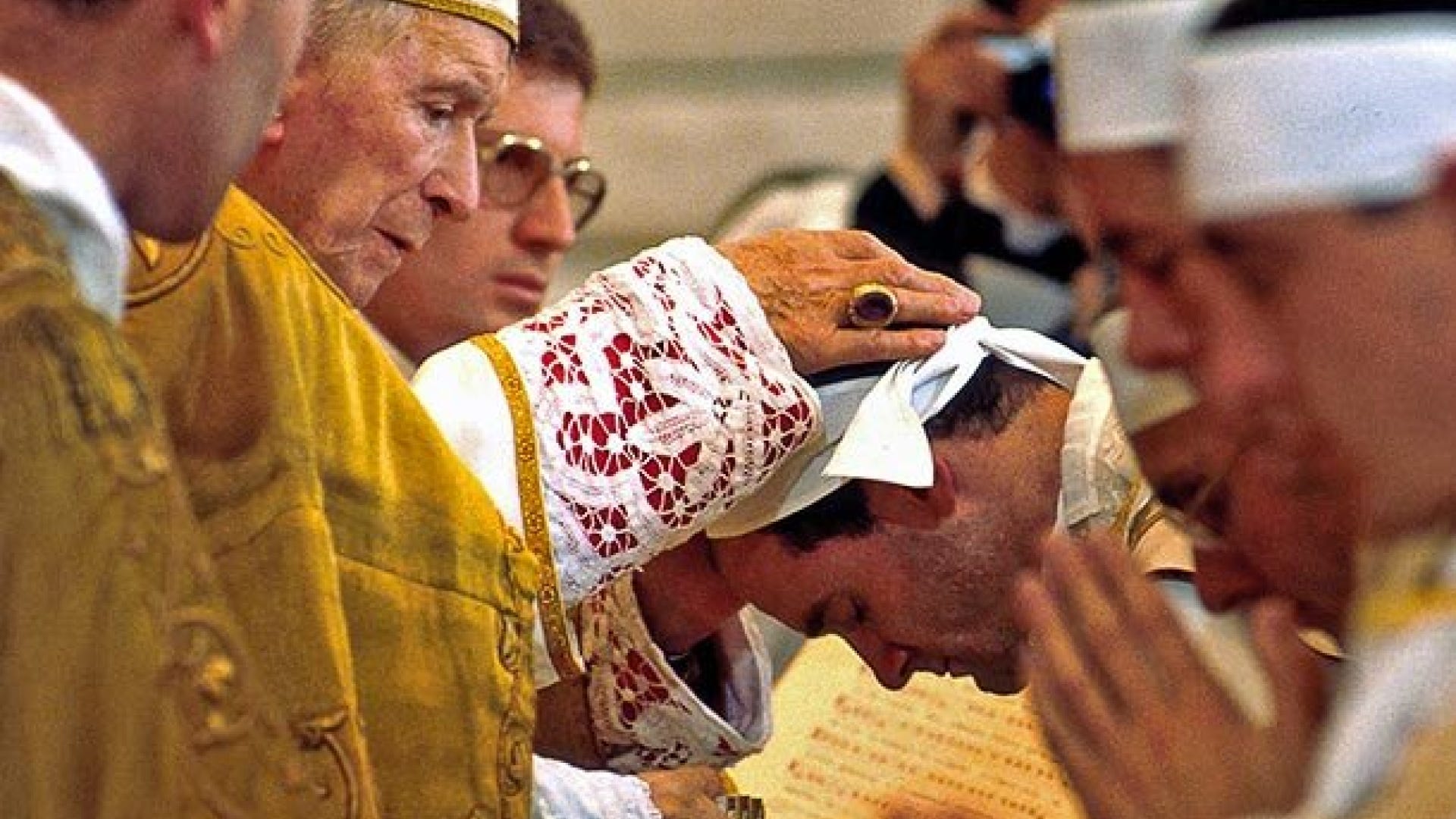
As mentioned in my last analysis on the subject, it has become a very popular Twitter argument at present to assert that episcopal consecrations against the will of the pope would be against divine law, meaning it would be wrong in every single instance, no exceptions. The argument is quite strong and can be terrifying for sensitive souls, as any arguments from Canon Law, conscience or charity would be made illegitimate, the act of consecrating bishops against the will of the Pope would be as wrong as adultery in every single instance. If this is so, you would think the Vatican would assert this immediately in the SSPX-Vatican talks. One would also think this would be reflected in the previous code of canon law. But these things aren’t realities, instead we are hearing this argument from polemicists and theologians on the internet. Let’s take one of the more popular citations from Pope Pius IX and try to figure out what is being asserted and how this could be used to make this argument from divine law:
“Others have gone even further and developed a theory that a proposal to entrust the care of the Armenians to Latin bishops is veiled in these words. Such foolish accusations indeed deserve no answer: for only fearful and foolish men could utter such statements. But We considered that We should not keep silence on Our right to elect a bishop apart from the three recommended candidates, in case the Apostolic See should be compelled to exercise this right in the future. But even if We had remained silent, this right and duty of the See of blessed Peter would have remained unimpaired. For the rights and privileges given to the See by Christ Himself, while they may be attacked, cannot be destroyed; no man has the power to renounce a divine right which he might at some time be compelled to exercise by the will of God Himself.” (Pius IX, Quartus supra, n. 31)
Firstly, we must acknowledge that this is an argument from authority. This does not make the argument illegitimate in itself, but rather the argument hinges on the authority of the one speaking. In this case, the argument is from the Supreme Pontiff in an Encyclical, which is certainly something to be taken seriously. However, the argument from authority is also dependent on the clarity with which the authority is speaking, we cannot read more condemnation or approbation than is deserved.
In this case, I do believe that this statement is enough to assert that the Holy See has authority over episcopal consecrations, and when taken with other statements of the magisterium of Pope Pius IX, that the Supreme Pontiff possesses full and immediate jurisdiction over every bishop in the world, and that a denial of this would be an attempt to renounce something that is of divine right (the power of the keys given to St. Peter by Christ)
What I do not believe that this proves is that the consecration of bishops against the will of the pope necessarily includes an act of formal contempt or a denial of Papal Primacy in itself. Here, in order to break down why exactly that is, we must first make a distinction. The proponents of those who argue that it would be against divine law in every instance to consecrate against the will of the pope do not argue that it would be against divine law in every instance to consecrate without the will of the pope. Such a position is untenable, as the early Church was full of examples of Bishops being consecrated without papal mandate. Those examples are enough to prove that this is not a law against divine origin, unless we are to be so brazen as to say that the vast majority of Church Fathers and the Early Church were unknowingly acting against divine law every time a bishop was consecrated without papal mandate.
I do wish to make a brief mention of the surface-level absurdity that would be presented if we were to say that the very fact that the Pope was opposed to the consecrations makes it, per se against divine law, no exceptions, rather than just against ecclesiastical positive law. In such a world, a Bishop who secretly consecrated a bishop without Papal mandate would be punished less, having only acted against ecclesiastical positive law, than the one who took the time to ask the Pope for permission in the first place. If the latter bishop was refused, suddenly his consecrations are against divine law in the same way that profaning the Eucharist would be, while the secret consecrator only has to deal with ecclesiastical positive law.
With that being said, understanding that we are speaking of consecrations against the express will of the Pope and not just without the will of the Pope, we now must ask what could make it against divine law in the first place. To understand this, we must find the moral object that would make it against divine law. Fr. Wuellner in his Dictionary of Scholastic Philosophy defines the moral object as the “term of the moral choice” which is more clearly defined by others as “The end chosen by the will.” The moral object here I believe is fairly clear, it would be “To confer episcopal orders on a validly ordained priest without papal authorization.” The question now becomes whether or not the latter part of this moral object would make this against divine law. The truth is that there is no divinely revealed precept directly prohibiting this. And while some assert that the Papal documents do so, you will notice that such documents never directly claim that “Thou shalt never confer episcopal orders without authorization” is a divinely revealed precept. The reason for this is simple, it is because the distinction between liceity and validity itself proves that consecration without papal mandate or against the will of the pope is not itself against divine constitution in the same way that the attempt to make a woman a bishop or a priest would be (which would be against divine law!). Because the act itself, no matter how illicit it is, still ontologically creates a bishop. If it were intrinsically against divine law in its object, the Church could not treat it as a true episcopal consecration as it would be against the divine constitution itself.

Continue Reading at Pelican Plus.
The claim that the act is against divine law would have to come indirectly through a change of moral species, meaning that the moral object would need to become “To act in defiance of papal jurisdiction as such.”
We should ask in this case, however, if the act itself necessarily entails such a change in moral species. Canon Law does not seem to think so. We can look at the often cited Canon 1323 which states:
“No one is liable to a penalty who, when violating a law or precept acted only under compulsion of grave fear, even if only relative, or by reason of necessity or grave inconvenience, unless, however, the act is intrinsically evil or tends to be harmful to souls; [or] acted, within the limits of due moderation, in lawful self-defense or defense of another against an unjust aggressor.
No one is liable to a penalty who, when violating a law or precept thought, through no personal fault, that some one of the circumstances existed which are mentioned in Numbers 4 or 5.”
And so, understanding that the act is not intrinsically against the good of souls or intrinsically against the divine constitution, it seems correct to see that it is at least possible that such an instance could exist where one could consecrate bishops against the will of the Pope without changing the moral character of the act to one that would be schismatic. For example, the moral object could be:
“To consecrate without mandate in an extraordinary crisis while affirming papal primacy.”
The SSPX seems to believe that this is exactly the present situation.
But I would like to go a bit further and perhaps slightly more polemical to point out the obvious double standard there is in citing Pope Pius IX in this circumstance. Would we be so comfortable in citing Pope Pius IX in his Syllabus of Errors and comparing them with what the United States Bishops say about religious liberty? Would we be so comfortable in seeing what Pope Pius IX said about non-Catholic religions and comparing that to the statement “All religions are ways to arrive at God” of Pope Francis?
No, this isn’t a red herring; the same principle is at play, which is that we need to look at the reality of the situation. Catholicism is not a religion where the only ones who truly understand what is and is not obligatory are theology nerds who have read obscure papal documents with interpretations that even the Vatican is unaware of existing. If the SSPX’s consecrations are the equivalent to say, profaning the Sacred Eucharist, then the Vatican should say so. At the moment, they are and have been citing canon law in a way that doesn’t imply this but rather implies that it goes against ecclesiastical positive law, in which case the SSPX has a much stronger position.
If even the Vatican doesn’t know that this is a matter of being per se against divine law, how could it even be properly promulgated? It seems to be the much clearer position that it is not intrinsically contrary to divine law in its object but would become so if coupled with schism expressed by formal contempt, a denial of the Papal primacy in principle. The papal documents of the past seem to use phrases about divine law about this because a crisis such as ours, where one would have to consecrate bishops in order to preserve the traditional Roman Rite and preserve parishes where the traditional faith was safely and reliably taught, was simply unthinkable.
The schismatic attitude that would accompany such an act to make it count as schismatic and therefore against divine law is not something that I believe the Society has done. The very fact that they have asked the Pope for permission suggests that they acknowledge that he has the authority in principle I understand and respect those who believe that they have a schismatic modus operandi, or simply are uncomfortable going that far due to other reasons. One might have a problem with the lack of ordinary mission of the SSPX, the marriage tribunals, or the lack of marriage delegation in many dioceses. Or one might disagree with the SSPX on whether or not the Novus Ordo is or can be considered “evil” in the sense that it is valid but deprived of certain goods. The real disagreement is there, I believe, and must be argued and discussed. It is a disagreement that would require looking at the crisis in the Church directly in the face, rather than broad appeals to authority that seek to condemn the SSPX and solve a 60-year debate with a wave of a hermeneutical wand. We should try to move the conversation forward.