

The consistory closed with Leo XIV echoing cardinals’ words by renewing his own appeal for peace, but there remains the sense that the entire affair avoided key issues of real substance for the Church.
A “precious moment” which must not be isolated, was how Pope Leo described the two-day consistory during his closing address on Saturday evening. “Little by little,” he said, “we are rediscovering the truest meaning of the Consistory: the gathering of the College of Cardinals around the Successor of Peter so that, through mutual listening and common discernment, the Holy Spirit may help the Pope to guide the Church.”
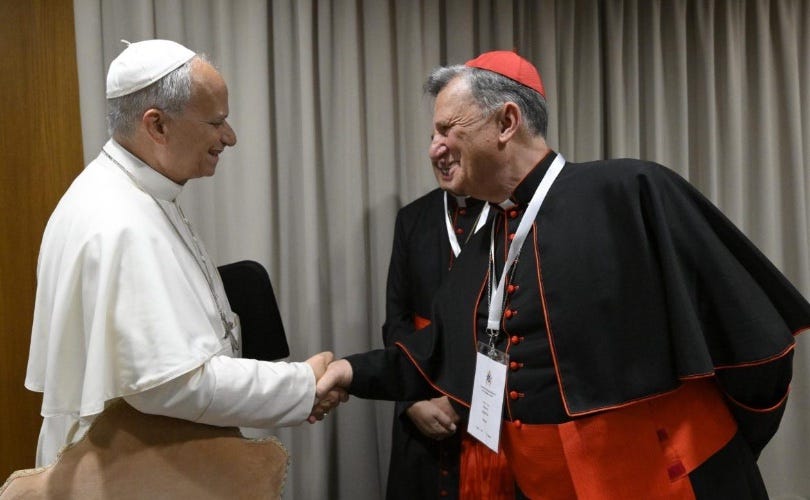
Convening a consistory is not “a parliament, not a congress where opinions or interests prevail,” he added, but rather “an experience of communion in the service of the mission.” Such language resonates very much with that used during the Synod, and this is no mere coincidence. The final of four sessions of the consistory dealt with the Synod’s implementation phase and the Synodal Assembly of 2028 – something which has caused much consternation to many of the more conservative bloc of cardinals in the College.
Introducing the fourth season, Cardinal Mario Grech stated that the implementation phase of the Synod “becomes a new stage in the reception of the Second Vatican Council and in the missionary renewal of the Church within the concrete realities of ecclesial life.”
Leo has appeared to be somewhat steering synodality in a different way to that envisaged by Pope Francis. While Francis made synodality a process of questioning everything the Church teaches and is, Leo seems to view it as a method of meeting in much more limited discussion, and with a narrower group – think bishops and cardinals rather than the lay-clerical mix of the Synod on Synodality.
Such a theory about Leo’s synodality was given some weight on Saturday when the Pope commented how the consistory had revealed synodality as not being about “who has the power to decide” – as the liberal activists wished it to be – but about “how do we together safeguard the gift that the Lord has entrusted to his Church?”.
If this question is placed at the center of the Church’s “discernment” then “shared responsibility, and decision-making find their proper place, illuminated by our mission and our common fidelity to the Gospel,” he said. “Thus, I wish to entrust to you once again the process of implementing the Synod.”
Synodality, the Pope stated, is “not a series of meetings, nor is it a working method. It is a spiritual style.” Be that as it may, the Pontiff’s words have not assuaged the concerns of many Vatican observers nor of cardinals critical of the Synod and its methodology.
There is also evidence that the consistory kept returning to bang the drum of synodality at the cost of engaging in any real debate about issues of doctrinal weight in the Church. As one curial cardinal told me, the discussion was very worldly in its attention rather than ecclesial. It focused more on vague platitudes about sociological issues rather than Church concerns, raising the plight of social and political division, polarization, and growing individualism. All of which are indeed serious issues, but they took priority over the crisis of doctrine and practice of the faith which is endemic in the Church.
Nor was there a formal discussion of the Society of Saint Pius X’s episcopal consecrations which are just days away, even though Cardinal Gerhard Müller raised the point during his personal intervention but which, he told me, did not seem to lead to any wider discussion on the point during the consistory itself. “The main theme was the reflection about the encyclical, the question of peace, artificial intelligence, human dignity,” Müller told me in a post-consistory interview. {His full intervention regarding the SSPX can be read online here}
Other cardinals expressed confusion about the purpose of the meeting, given the somewhat benign agenda. In contrast, some like Cardinal Jean-Claude Hollerich hailed it as a success, telling me that it is “wonderful how the Holy Father acts for unity in the Church.” Cdl. Grech was similarly enthused about the consistory. “Our collegiality, no less than synodality, is a hospitable space capable of welcoming anew the presence of the Lord in the Spirit,” he told the assembly.
During the final session, some of the small-table groups spoke of the “need to further explore and put into practice the ascetic and historical dimensions of synodality, as well as on the need to offer the clergy a vision of the priesthood that is beautiful, creative, and evangelical, yet at the same time non-clerical.” Quite exactly what this means was not elaborated, nor has the Vatican chosen to provide any further answers about it – including not holding the press conference planned for the consistory’s closing.
Yet another element which marked the recent consistory is small table discussion groups, which sees the workings of said groups very much controlled by the fact that the entire group has to agree on their table’s workings before they can submit their group report to the floor. While this might rule out the occasional vocal activist for LGBT ideology, it also effectively silences the voices of those cardinals keen to raise doctrinal or liturgical concerns.
It resembled “more a brainstorm than a reflected” conversation, Cardinal Müller commented. The former CDF prefect renewed his preference for the traditional plenary discussion, saying that “we are not only some group collected or individuals coming together. We are constituted as a college. The college must be together.”
Another curial cardinal echoed these concerns, noting that it affords no room for doctrinal concerns to be raised, if they are not shared by all at the table. After January’s consistory many cardinals desired to return to the traditional style, expressing discontent at the effectiveness of the table groups.
Nevertheless Leo appears keen to retain the new style of the round table method at the consistory in the name of synodality, and directly instructed the cardinals during this consistory that the style is here to stay. The irony is that it actually curtails the cardinals’ free speech far more than the traditional format – but that is something which many curial officials who rose to prominence under Pope Francis will be very content with.
True, an email has been set aside for cardinals to reach the Pope on, but there is doubt expressed by some in the College as to whether such communication is effective or indeed as private as was described.
As for what exactly were the issues raised during the brief time allowed for free interventions on Saturday evening, the Vatican has not provided any information. When speaking to this correspondent and The Pillar’s Edgar Beltran, Cardinal Hollerich beamed and simply replied “everything” when asked about what was discussed.
Without a doubt, peace was a consistent theme raised by both cardinals and Pontiff. Making a closing speech, Leo made his appeal: “Let us say this to our brother bishops, to the Churches entrusted to our ministry, and to all the peoples of the earth: God desires peace for every nation and every people.”
But the discussion leaned heavily on the generic and vague, rather than specific and precise. Commenting on this, Müller told me that there is a kind of secular temptation to have the Church “now speaking for peace or to make some anti-Trump remarks,” but he warned “that cannot be our level. “We have more to say,” he urged. “Peace is coming by Jesus Christ. I will give you the peace which the world is not giving you.”
Related to peace is of course the element of the Just War Doctrine: something which had been inserted into the consistory following the publication of Leo’s encyclical but which was then removed. Despite this the topic did arise in the conversation, with a number of the small groups speaking of “the need to move beyond the logic of just war, since the Gospel cannot be imposed by force, and instead to speak of the right to proportionate self-defense.”

On this point about any potential overhaul of teaching, Müller urged caution and nuance. The Church’s greatest weapons are spiritual, he noted, but added that by its very nature the Vatican practices the Just War Doctrine since it “is defended by the Swiss Guard who have to give their lives for the Pope in case of attack.”
One aspect welcomed widely by the College is that Leo does intend to make the consistories annual affairs, with the 2027 date being announced at some point later this year. Further information which may yet be released by the Vatican about this weekend’s consistory will be available on Pelican+.

…“we are rediscovering the truest meaning of the Consistory: the gathering of the College of Cardinals around the Successor of Peter…”. Pope Leo is so brainwashed, it’s quite sad to witness