

The Vatican is seemingly once again moving further away from Fiducia Supplicans, as the Coptic Orthodox have resumed ecumenical dialogue with the Holy See following private reassurance from Pope Leo that same-sex couples would not be blessed.
On May 22, the Holy Synod of the Coptic Orthodox Church issued a statement summarizing recent decisions by the Synod, including one element which has great import also for the Catholic Church.
According to the official text:
“The members of the Holy Synod decided to resume theological dialogue with the Catholic Church following the assurances regarding the non-blessing of same-sex couples, which were expressed during the telephone conversation between His Holiness Pope Tawadros II and His Holiness Pope Leo XIV on Friday, May 15 of this year.”
The Coptic Orthodox broke its ecumenical relations with Rome following the December 2023 publication of Fiducia Supplicans, which authorized the blessing of same-sex couples.
In the wake of international outcry in the Church, Pope Francis and Cardinal Victor Manuel Fernández, the text’s author, were forced to defend the document vigorously. They also subsequently tried to argue that the document did not deal with blessing of couples. However the text is clear: “Within the horizon outlined here appears the possibility of blessings for couples in irregular situations and for couples of the same sex, the form of which should not be fixed ritually by ecclesial authorities to avoid producing confusion with the blessing proper to the Sacrament of Marriage.”
Thus in a March 7, 2024 announcement, the Coptic Synod declared its “rejection of same-sex relations, supporting her belief with many biblical verses that clearly declare the rejection of such relationships that are contrary to the human nature that God has created.” The Synod also stated: “after consulting with the sister churches of the Eastern Orthodox family, it was decided to suspend the theological dialogue with the Catholic Church, reevaluate the results achieved by the dialogue from its beginning twenty years ago, and establish new standards and mechanisms for the dialogue to proceed in the future.”
Expanding on this via a subsequent video statement and summary of the synod, Coptic spokesman Father Moussa Ibrahim affirmed that the break in dialogue was a direct result of what he described as “the change of position of the Catholic Church regarding the issue of homosexuality.”

The Coptic Orthodox, led by Patriarch Tawadros II of Alexandria do not accept the authority of the Roman Pontiff, though dialogue between Rome and the Copts has been underway since 1973. The break in ecumenical relations in 2024 was viewed as a sudden overturning of dialogue that had been warmly underway for 50 years.
Only shortly prior to Fiducia Supplicans’ publication, Tawadros II had made a visit to Rome where amongst a series of historic events he gave an address at the weekly general audience which Pope Francis holds at the Vatican. Following this, Tawadros celebrated a Coptic liturgy inside the Papal Archbasilica of St. John Lateran’s for the Coptic faithful based in Italy.
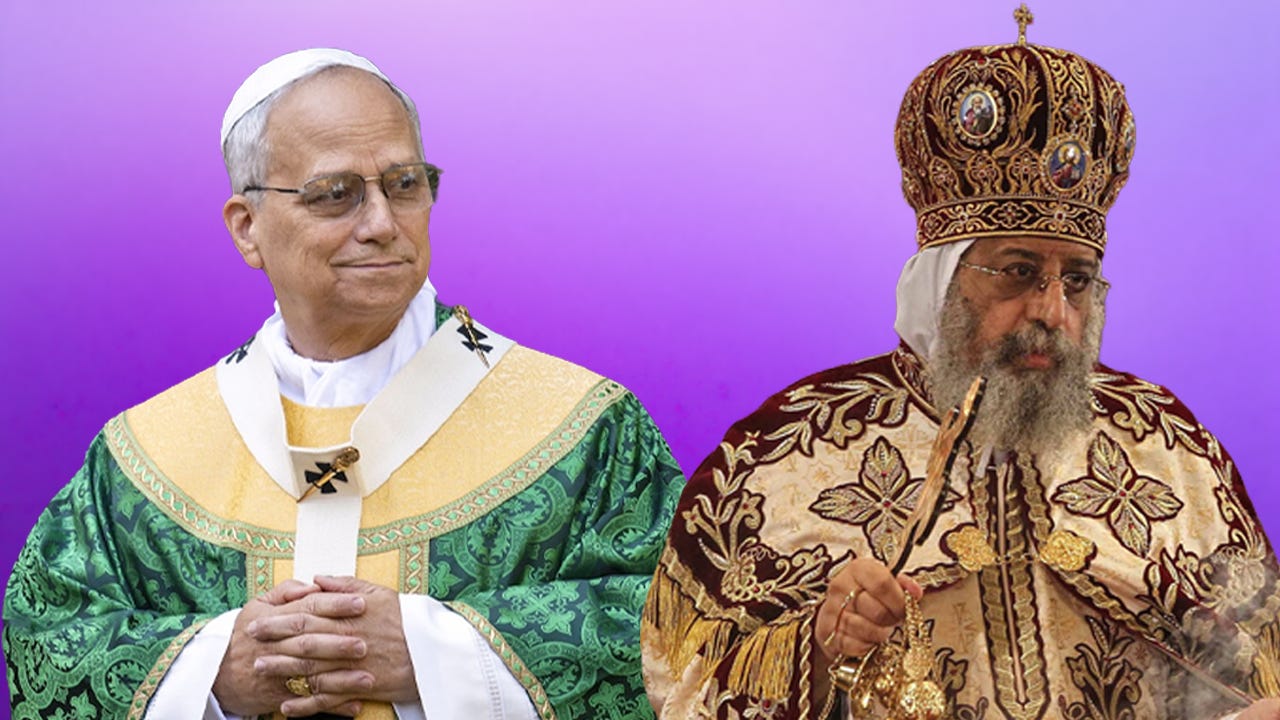
But Fiducia Supplicans put an end to the blossoming relationship that existed between the two churches, and also cooled that which existed between Francis and Tawadros.
It was following the election of Leo XIV that relations began to thaw. Tawadros II called the new American Pontiff to congratulate Leo and extend an invitation to visit Egypt. This marked a notable improvement in relations, and Leo has indeed made the issue of unity among Christians a key desire of his early months as Pope.
Fiducia Supplicans still remains very much in force, just as the doctrinal opposition to it across the Church remains equally vigorous.
But returning from Africa Leo signaled that the substance of the controversial text might, quietly, be done away with.
Fielding a question about the German bishops’ plan to bless same-sex couples, Leo rejected the possibility of such a ceremony. “The Holy See has already spoken to the German bishops,” he said. “The Holy See has made it clear that we do not agree with the formalized blessing of couples, in this case, homosexual couples, as you asked, or couples in irregular situations, beyond what was specifically, if you will, allowed for by Pope Francis in saying all people receive blessings.”
Leo thus rejected the possibility of blessing same-sex couples, while also appearing to change the record. Following the furor over Fiducia Supplicans, Pope Francis did say that all people can be blessed as has been the case throughout the Church’s history. However, Francis had previously gone further than that, by stating in the ill-fated document that there is “the possibility of blessings for couples in irregular situations and for couples of the same sex.”
In selectively choosing certain of Francis’ statements on the topic of same-sex blessings, and whitewashed others from history, Leo gave the impression to many observers that Fiducia Supplicans was, in effect, dead.
It is likely this element which has given renewed impetus to the Coptic desire to renew ecumenical dialogue.
Indeed, something must have convinced the Coptic Synod of a marked change emanating from the Holy See encouraging them to return to the dialogue table, when previous attempts had failed. Cdl. Fernández visited the Coptic leaders in May 2024, following their break of ecumenical relations. It was essentially an apology trip and a move to rekindle relations – one which appeared to ultimately and spectacularly fail.
Under Leo, however, the Coptic Synod has reversed course after receiving reassurances from the Pontiff that the Catholic Church does not bless same-sex couples. This can only mean that Leo has affirmed something privately to the Orthodox which Fernández could not, or would not, in 2024.
Fiducia Supplicans remains alive and in force – although critics question its legality given its rejection of doctrinal orthodoxy. But in practice, it appears as though Leo is gradually effecting a shift in actual policy: overturning the controversial text in practice just not formally.

I'm beginning to wonder just who is running the show. Leo or Fernandez?
>Fiducia Supplicans remains alive and in force – although critics question its legality given its rejection of doctrinal orthodoxy.
What orthodoxy does it reject? As the article says, it only really admits that anyone can receive an informal blessing.